








back to : hydraulic control valves
How to connect a hydraulic control valve?
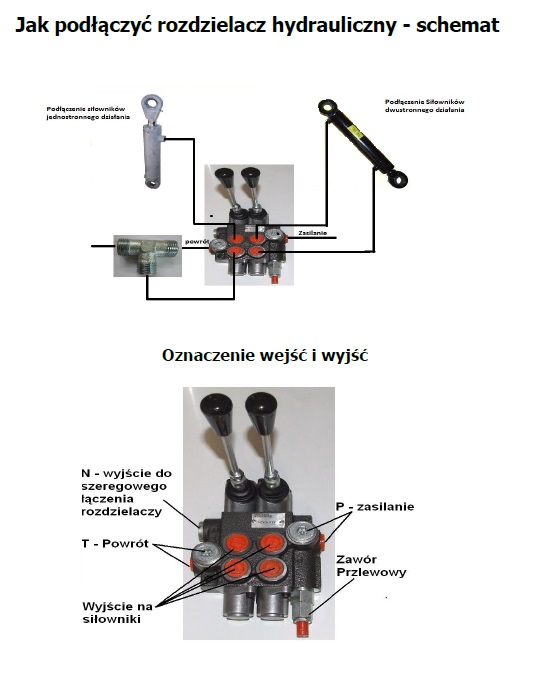
Connecting a hydraulic control valve requires knowledge of markings and the oil flow diagram. Thanks to the use of appropriate pressure carry-over plugs, it is possible to easily connect sections, which allows for extending the capabilities of the hydraulic system and its adaptation to more demanding applications. Click here on the tab HYDRAULIC CONTROL VALVES to check the offer of hydraulic control valves. Our offer includes, among others, control valves, parts for control valves, nipples for control valves, and hydraulic hoses for connecting cylinders.
Click here to download the guide on connecting control valves
- P = supply
- T = return
- N = outlet for serial connection of the control valve
How to connect a hydraulic control valve ?
Connecting a hydraulic control valve is a key stage in the installation of a hydraulic system and requires precision and knowledge of the markings on the device. Hydraulic control valves control the flow of oil in the system, allowing control over the operation of cylinders and hydraulic motors. Steps for connecting a hydraulic control valve: 1) Checking port markings – Each control valve has input and output markings that must be correctly connected: P (Pressure) – the supply port to which the supply line from the hydraulic pump is connected. T (Tank/Return) – the return port, discharging oil to the tank. A and B – working ports to which consumers, e.g., cylinders or hydraulic motors, are connected. N (Neutral, BYPASS) – in some models, used for oil flow bypass. 2) Installation of hydraulic lines – It is important to use lines with the appropriate diameter and resistance to operating pressure to ensure safety and performance efficiency. 3) Use of safety valves – In some installations, it is recommended to install relief valves to protect the system against overload. 4) Testing correct operation – After connecting the control valve, check the correctness of the oil flow and the response of the system to the control.
Markings in hydraulic control valves
Markings used in hydraulic control valves help in the correct assembly and configuration of the system. The most common markings include:
- P – Pressure inlet (Pressure)
- T – Return to tank (Tank)
- A, B – Consumers (e.g. cylinders)
- N – Neutral oil bypass
- X and Y – Ports for hydraulic control, used in pressure-controlled valves
- L – Connection for pressure gauge (for pressure control)
- C, D – Additional ports, e.g., for connecting additional sections in the control valve
Connecting hydraulic control valves – pressure carry-over plug
Hydraulic control valves can be connected in series, which allows for system expansion and control of a larger number of cylinders or consumers. For this purpose, pressure carry-over plugs are used, which enable the assembly of subsequent sections without the need for additional separation of oil flow. One of the elements used for this type of connection is Control valve pressure carry-over plug G1/2" 45l/min. This plug ensures: Safe connection of control valve sections – enables oil flow between subsequent elements of the system. Quick assembly – does not require complicated processing or additional lines. Increased control possibilities – expansion of the hydraulic system with subsequent control sections. In practice, connecting control valves through pressure carry-over plugs allows for flexible adaptation of the system to the requirements of machines and hydraulic devices, without the need for additional pumps or main control valves.