










O-ring & seal kits
Produkty z kategorii
O-ring seal kits
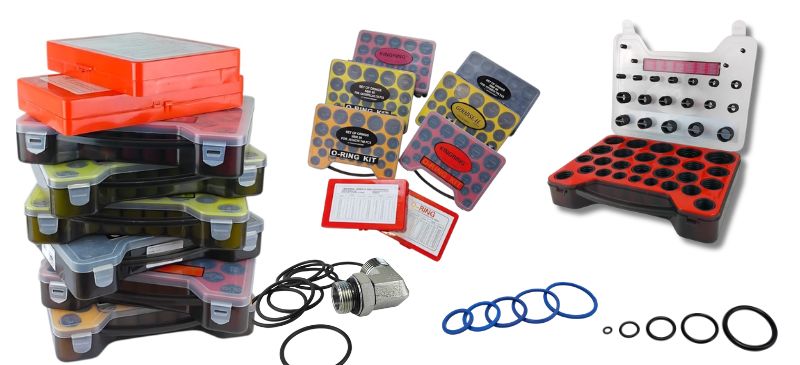
Oil-resistant O-rings for power hydraulics
NBR nitrile rubber O-rings are among the most well-known and widely used types of seals. In our offer, you will find sets commonly referred to as O-ring "boxes" intended primarily for connecting all types of power hydraulic fasteners. They are widely used in hydraulic and pneumatic drives and controls, in dynamic and static connections. Ideal for use as seals in pumps, drive belts, and other general technical applications. They appear, among others, on the cones of hose crimping fittings and as seals in all types of threaded connectors.
Types of sets offered :
- metric O-ring set ( thin )
- inch O-ring set ( thick )
- air conditioning O-ring set ( green )
- ORFS ( very thin )
O-ring applications :
NBR O-rings are intended for contact with fats, greases, and an optimal operating temperature up to (+70 °C). Temperature range -30 °C to +100 °C (prolonged contact with extreme temperatures should be avoided). Suitable for contact with: mineral oils, HFA, HFB, HFC hydraulic fluids under pressure. They also have good mechanical properties (elasticity, abrasion resistance). Unsuitable for contact with glycol-based brake fluids, HFD type fluids, aromatic compounds (benzene, esters, ketones, and amines, as well as concentrated acids and lyes), ozone.
Oil-resistant O-rings used in power hydraulics
Oil-resistant O-rings are extremely important components in power hydraulics. They provide a seal between components of the hydraulic system, preventing oil leaks and maintaining proper pressure. They offer high resistance to oils and other working fluids used in hydraulics. Oil-resistant O-rings are made of high-quality elastomers, such as nitrile (NBR), fluorocarbons (FKM), or ethylene-propylene-diene-monomer (EPDM). Each of these materials has its unique properties and is tailored to different operating conditions. Oil-resistant O-rings are used in various hydraulic system components, such as hydraulic connectors, hoses, valves or cylinders. Their main task is to ensure tightness in places where movement, pressure, or temperature occurs. Features of oil-resistant O-rings: Chemical resistance: O-rings are resistant to oils, greases, fuels, and other working fluids, allowing the hydraulic system to operate reliably for a longer period. Elasticity and resilience: O-rings are elastic and resilient, enabling effective sealing even under conditions of changing pressure and temperature. Easy replacement: O-rings are relatively inexpensive and easy to replace, allowing for quick repairs and maintaining the continuity of the hydraulic system's operation. In summary, oil-resistant O-rings are essential elements in power hydraulics, ensuring reliable sealing and protection against oil leaks. Thanks to their high quality and resistance to working fluids, they guarantee the efficient and effective operation of the hydraulic system.
Rubber O-rings
Rubber O-rings are basic sealing elements used in hundreds of different systems – from hydraulic systems and pneumatic, to automotive, industry, and home technical devices. Their task is to ensure a tight connection between two surfaces, which protects the system against leaks of oil, air, water, or other working media. Thanks to their simple, round design and the elastic properties of the material, O-rings can work in both static and dynamic connections, guaranteeing stability and reliability even in difficult conditions. In practice, rubber O-rings are made from various compounds, such as NBR, FKM (Viton), EPDM, or silicone, allowing the selection of the right model for a specific working environment. Each type is characterized by different chemical, thermal, and mechanical resistance. This makes it possible to effectively seal systems exposed to high temperatures, aggressive media, intense pressures, or movement of working elements. In the automotive industry, O-rings are used, among others, in fuel line connections, power steering hydraulics, cooling systems, or air conditioning systems.
Hydron's offer includes practical O-ring sets that allow for quick repairs and service without having to search for individual items. The sets cover various diameters and thicknesses, so they can be adapted to most popular applications in power hydraulics, pneumatics, and vehicle mechanics. This solution is particularly helpful for service centers, workshops, and professional users who need to always have a set of reliable seals at hand. Rubber O-rings from the sets category available at Hydron are carefully selected for quality and resistance to loads encountered in the operation of technical systems. Thanks to a wide range of materials and sizes, it is possible to quickly select the right seal for a specific application, which affects the reliability of the entire system, prevents failures, and reduces service costs. If you need solid, universal seals, the rubber O-ring sets available in the store will be a convenient and effective solution that will improve the quality of work of every installation.
What are oil O-ring sets?
Oil O-ring sets are special sets of seals made of materials resistant to oils and greases. Their name comes from the properties of these elements – they are adapted to work in environments where contact with various types of oils (mineral, synthetic, hydraulic) is unavoidable. As a result, they are commonly used in lubrication systems, pumps, engines, and hydraulic systems where sealing reliability is crucial. The oil O-ring set was designed for operation in conditions involving contact with hydraulic oils, greases, and other chemical substances. The O-rings are usually made of high-quality NBR rubber (nitrile rubber), which is characterized by high resistance to mineral oils, fuels, and fats. This guarantees tightness and work safety in power hydraulic systems.
Hydraulic O-ring sets
Hydraulic O-ring sets are a group of seals dedicated to power hydraulic applications. These precision-made O-rings are designed to work in high pressure and variable temperatures, typical of hydraulic systems. They are used in hydraulic cylinders, valves, and other components where a durable and tight connection is essential. Hydraulic O-rings are made of materials such as NBR (nitrile rubber), which guarantees resistance to hydraulic oils and long life even in demanding conditions. Hydraulic O-ring set is a practical and essential solution for every workshop, service center, or industrial plant where fast and effective repair of hydraulic and pneumatic systems matters. Thanks to ready-made sets of various sizes, you can easily match the appropriate sealing element without having to order individual parts every time.
Rubber O-ring sets
Rubber O-ring sets are versatile seals that will work in a wide range of applications. Made of flexible and durable rubber, they offer excellent sealing in dynamic and static conditions. Their main advantage is versatility – they can be used in hydraulics, mechanics, industrial installations, or cooling systems.
Inch O-ring sets
Inch O-ring sets are products adapted to the requirements of hydraulic and mechanical systems based on inch standards, popular especially in North America and industrial sectors. Precision manufacturing in inch standards allows for their easy integration with devices produced according to these specifications. This makes them a reliable choice for international applications.
Metric O-ring sets
Metric O-ring sets are an excellent solution for systems and machines that are based on the metric system. These are the most commonly used seals in Europe, valued for their precision and ease of matching with standard components. Thanks to the variety of dimensions, metric O-rings work well in many industries, such as automotive, machine industry, or power hydraulics.
O-ring material
Here are some examples of typical oil-resistant O-rings used in power hydraulics:
-
Nitrile (NBR) O-rings: This is a popular material used for O-rings in hydraulics. It has good resistance to mineral oils, greases, and fuels. NBR is also characterized by good elasticity and durability.
-
Fluorocarbon (FKM/Viton) O-rings: FKM material is more resistant to high temperatures and aggressive liquids such as synthetic oils, silicone oils, and some solvents. FKM O-rings are commonly used in demanding applications where high temperatures and aggressive environments occur.
-
Ethylene-Propylene (EPDM) O-rings: EPDM is characterized by excellent resistance to weather conditions, ozone, and UV radiation. It is a material often used in O-rings that are exposed to external factors.
-
Polyurethane (PU) O-rings: Polyurethane O-rings are used in applications where high resistance to abrasion and mechanical damage is required. They are also flexible and have good resistance to oils and solvents.
O-ring kit
O-ring kits are essential sealing sets used in power hydraulics, pneumatics, and other branches of industry. O-rings made of nitrile rubber (NBR) are characterized by high resistance to oils, greases, and temperatures in the range of -30°C to +100°C, which makes them ideal for use in demanding conditions. Types of available O-ring sets: ✔️ Metric O-ring sets: Contain O-rings with standard metric dimensions, often with smaller cross-sections, intended for precision applications. ✔️ Inch O-ring sets: Include O-rings with dimensions in inches, usually with larger cross-sections, used in systems based on imperial units. ✔️ ORFS O-ring sets: Specialized O-rings with very thin cross-sections, dedicated to seals in ORFS (O-Ring Face Seal) connector systems. ✔️ Air conditioning O-ring sets: Contain green O-rings intended for air conditioning systems, resistant to refrigerants and high pressures. O-ring applications: NBR O-rings are widely used as seals in pumps, hydraulic hoses, threaded connectors and other components of hydraulic and pneumatic systems. Their flexibility and abrasion resistance provide effective sealing in dynamic and static connections.
Large O-ring set – wide selection of sizes in one case
A large O-ring set is the ideal choice for professionals who need to have a wide range of diameters and thicknesses always at hand. The kit usually contains several hundred O-rings in various versions, placed in practical organizers. As a result, a hydraulic or mechanical service can save time and ensure immediate availability of the appropriate seal.
Thin O-ring set
In many machine and device designs, thinner O-rings are needed that perfectly fit into narrow sealing grooves. A set of thin O-rings allows for quick selection of the right element, which is of great importance in precision mechanisms and in places where lightness and connection tightness matter.
O-ring and washer sets – comprehensive sealing solutions
Hydron's offer includes professional O-ring sets that work well in both hydraulic services and industrial workshops. Having kits in practical organizers saves time and provides access to various seal sizes in every situation. This makes it possible to quickly match the right element without machine downtime.
Types of O-rings and their application
Various types of O-rings are available on the market, adapted to specific working conditions. Oil O-rings are very popular as they show high resistance to technical oils and greases. Many installations also use NBR O-rings, characterized by excellent durability and a wide range of operating temperatures. It is also worth mentioning solutions such as a quad-ring set, which is an alternative to traditional seals and is used in more demanding systems.
Rubber and oil O-ring set
A professional rubber O-ring set guarantees that every mechanic or technician will be prepared for various service situations. Particularly useful is an oil O-ring set, which includes elements made of oil-resistant rubber. Such kits work great in power hydraulics, pneumatics, and industrial machines where contact with oils, fuels, and greases occurs.
O-ring sizes and hardness
Selecting the right seal requires knowledge of parameters such as O-ring sizes or O-ring hardness. Our store offers elements in many variants, from standard to specialized, allowing for precise matching to device designs. Inch O-ring dimensions are also popular in industry, being used in machines manufactured according to American standards.
Materials used in O-rings – EPDM, NBR, and Viton
O-rings are small but extremely important sealing elements that play a key role in ensuring the tightness of hydraulic, pneumatic, water, and industrial systems. Depending on the working conditions and the type of medium they come into contact with, different rubber materials with varying chemical and thermal properties are used. The most common materials used in the production of O-rings are EPDM, NBR, and Viton (FKM). Each of them has unique features that determine their suitability for specific applications.
NBR O-rings – universal seals for oils and fuels
The most popular and widely used material in O-ring production is NBR, i.e., nitrile rubber. Its immense popularity stems from a combination of very good technical parameters, an attractive price, and a wide range of applications. O-rings made of NBR are perfect wherever there is contact with mineral oils, fuels, greases, and hydraulic fluids. Thanks to its structure, NBR is a material resistant to abrasion, stretching, and pressure, which makes it successfully used in hydraulic systems, cylinders, valves, pumps, and oil installations. NBR O-rings maintain flexibility in temperatures from about -30°C to +100°C, and in special versions even above +120°C. It is also significant that NBR O-rings are easy to install and maintain tightness for a long time, provided they are not exposed to ozone, UV rays, or high temperatures. For this reason, they are primarily used in indoor applications and closed systems where they are not exposed to direct atmospheric conditions.
EPDM O-rings – ideal for water, steam, and outdoor applications
The second very common choice is EPDM, i.e., ethylene-propylene-diene rubber. This material handles the water environment exceptionally well and wherever there is contact with hot water, steam, glycol, cooling solutions, and atmospheric factors. EPDM stands out with excellent resistance to ozone, UV radiation, moisture, and variable weather conditions, which is why O-rings made of this material are commonly used in water and heating installations, pneumatics, and the sanitary and food industries. Their operating range is wide – from -40°C to as much as +150°C, making them an excellent choice for high-temperature environments. Unlike NBR O-rings, EPDM seals are not resistant to oils and petroleum products, so they should not be used in oil-based hydraulic systems. On the other hand, they work perfectly in cooling systems, water supply systems, as well as in applications with DOT 3 or DOT 4 type brake fluids, where other elastomers could be destroyed.
Viton (FKM) O-rings – premium class resistance
The most technologically advanced material used in O-ring production is Viton, also known as FKM or FPM. This is a fluoroelastomer with exceptional chemical and temperature resistance, used in places where other materials fail. O-rings made of Viton are characterized by resistance to mineral and synthetic oils, fuels, acids, solvents, and high temperatures reaching up to +200°C. Furthermore, they are resistant to ozone, UV radiation, and atmospheric factors, which is why they are used in the most demanding industrial and hydraulic systems. They have found wide application in the chemical, petrochemical, automotive, and power industries. Thanks to their thermal stability, Viton O-rings are perfectly suited for work in high-pressure environments where not only tightness but also long-term reliability is required. It is a premium class material, chosen by specialists who prioritize the safety and durability of the system.
How to choose the right O-ring material for an application?
Choosing the right O-ring material should always depend on the working medium, operating temperature, pressure, and environmental conditions. If the seal is to work in contact with hydraulic oil, NBR will be the best choice. In water, heat, and steam systems, EPDM will work much better, while in an environment of aggressive chemicals or high temperatures – Viton (FKM) will be irreplaceable. Proper selection of material not only increases the durability of the seal but also minimizes the risk of failure, leaks, and machine downtime. It is a seemingly small element that has a huge impact on the safety and efficiency of the entire system.
O-rings – reliable seals in hydraulics and pneumatics
O-rings are some of the most commonly used sealing elements in hydraulic and pneumatic systems. Thanks to their simple yet effective design, they ensure tightness even at high working pressures. Hydron's offer includes rubber O-rings, sealing O-rings, and complete O-ring and washer sets that allow for the quick selection of appropriate seals for any application.
O-ring materials and properties
The most commonly used material is NBR (nitrile rubber), resistant to hydraulic oils, greases and fuels. Versions with increased hardness, such as NBR 90, are dedicated to working at high pressures and temperatures. For demanding environments involving aggressive chemical media or extreme temperatures, silicone O-rings are an ideal choice – flexible, durable, and resistant to aging. The offer also includes oil-resistant O-rings and oil O-rings, which are used in lubrication and power hydraulic systems.
O-ring dimensioning and types
Selecting the right O-ring is based on accurate O-ring dimensioning, including internal and external diameters and cross-section (thickness). At the Hydron store, we offer both metric O-rings and inch O-rings, allowing for matching with any type of connector. For applications where mounting space is limited, thin O-rings work perfectly, maintaining high tightness with minimal thickness.
Selecting O-rings and practical application
When selecting O-rings, both working conditions and the type of medium – oil, grease, hydraulic fluid, or refrigerant – should be taken into account. In power hydraulics and pneumatics oil-resistant O-rings are used in hydraulic pumps, cylinders, valves, hoses, and connectors, providing safe and tight connections. Special versions, such as air conditioning O-rings made of resistant material, guarantee tightness in cooling and air conditioning systems.
Hydron's assortment includes complete O-ring sets containing a wide range of sizes and materials. This solution allows you to quickly find the right O-ring without the need for precise measurements. The offer also includes special air conditioning O-ring sets and thin O-ring sets for ORFS-type hydraulic connections. All products meet O-ring standards and comply with international dimensional standards.
NBR 90 O-ring
NBR 90 O-ring is a sealing ring of the O-ring type made of NBR rubber (nitrile rubber – Nitrile Butadiene Rubber) with a hardness of 90° Shore A. It is one of the most commonly used types of seals in power hydraulics, pneumatics, and industrial installations working with oils and fuels. The O-ring has a characteristic round cross-section, thanks to which, after being installed in a sealing groove, it is pressed by the system components and creates a tight barrier preventing the leakage of the working medium.
What does the NBR 90 designation mean ?
The symbol NBR 90 contains two pieces of information regarding the material and its mechanical properties. NBR stands for nitrile rubber, a material resistant to hydraulic oils, greases, fuels, and many chemical substances used in hydraulic systems and pneumatics. The number 90 indicates the hardness of the material – 90 Shore A, which is relatively hard rubber. Standard O-rings most often come in hardnesses of 70, 80, or 90 Shore. The 90 version is much more resistant to high pressure and deformation.
Properties of NBR 90 seals
O-rings made of NBR rubber with a hardness of 90 are characterized by very good resistance to working conditions encountered in power hydraulics. This material works well with hydraulic oils, greases, and fuels, making it widely used in systems of industrial, agricultural, and construction machinery. Typical properties of NBR 90 O-rings include high resistance to mineral oils, good mechanical strength, resistance to abrasion, and dimensional stability when working under high pressure. This material maintains its properties at temperatures usually ranging from about –30°C to +100°C, making it a universal solution for many technical installations.
Application of NBR 90 O-rings in hydraulics
NBR 90 O-rings are primarily used in places where the seal must withstand heavy loads and high working pressures. They are found, among others, in hydraulic connectors, valves, hydraulic pumps, distributors, and in hydraulic cylinders. In power hydraulics rings of this type seal threaded connections and the end surfaces of installation components. They are very often used in ORFS and BSP connectors with a flat seal or in special sealing seats used in hydraulic fittings.
Where NBR 90 O-rings are used
Seals made of this material can be found in many industrial sectors. They are most commonly used in power hydraulics, pneumatics, agricultural machinery, construction machinery, industrial equipment, and in oil and fuel installations. Thanks to their resistance to oils and high hardness, NBR 90 O-rings are perfect for systems operating in difficult service conditions. The NBR 90 O-ring is a rubber seal with high hardness intended for use in oil and hydraulic installations. The combination of NBR material and 90 Shore hardness ensures high resistance to pressure, deformation, and contact with hydraulic oils. This is why seals of this type are very often used in power hydraulic components such as hydraulic connectors, valves, pumps, or distributors.
O-rings for power hydraulics
O-rings for power hydraulics are basic sealing elements in systems operating under high pressure. They are elastic rings with a circular cross-section that, when installed in the appropriate groove, are compressed, creating a tight connection between two surfaces. Thanks to their design, they effectively prevent leaks of hydraulic oil and protect the system against the entry of contaminants. In power hydraulics O-rings are used in pumps, valves, cylinders and hydraulic connectors, where they are responsible for maintaining full tightness even at varying pressures and temperatures. As the medium pressure increases, their sealing efficiency further increases, which makes them one of the most reliable and most frequently used solutions in industrial installations. O-ring sets available at Hydron allow for the quick selection of the appropriate size and material for a specific application. Depending on the operating conditions, NBR O-rings resistant to oils and fuels, FKM (Viton) for high temperatures, and EPDM for water and atmospheric factors are used, among others. Proper selection of the seal has a direct impact on the durability of the entire system, reduction of failures, and the operational reliability of hydraulic machines and equipment.
Check also: Click and check the dimensions of O-rings used in hydraulic hose fittings

expand text NBR O-rings – key information
What is an NBR O-ring?
An NBR O-ring is a seal made of nitrile rubber, which is characterized by very good resistance to hydraulic oils, fuels, greases, and many chemical substances. NBR material is one of the most commonly used elastomers in power hydraulics, pneumatics, and industrial machinery. NBR O-rings provide static and dynamic tightness, work well in a wide range of temperatures, and are durable when in contact with mineral oils.
What are the types of O-rings?
O-rings come in many versions selected for the type of medium, operating temperature, pressure, and environmental conditions. The most popular include oil-resistant NBR O-rings, FKM/Viton O-rings for high temperatures and chemicals, EPDM O-rings used in water and brake fluids, silicone O-rings working at low temperatures, and HNBR O-rings with increased resistance to aging and temperatures. They also differ in hardness, color, diameter, and manufacturing type, so they can be precisely matched to any system.
How to correctly select an O-ring?
Selecting an O-ring requires considering the internal diameter, cross-section diameter, and type of material. It is important that the seal is matched to the mounting groove, static or dynamic work, and the medium that will come into contact with the rubber. The range of temperatures and pressures in which the O-ring will work should also be checked. A correctly selected O-ring ensures the tightness, durability, and safety of the hydraulic or pneumatic system.
What are green O-rings for?
Green O-rings are most often made of FKM/Viton material and intended for work in demanding chemical conditions, high temperatures, and aggressive environments. They are used in air conditioning systems, compressors, chemical installations, fuel systems, and in places where ordinary NBR O-rings could be damaged. The green color facilitates their quick identification during service.
What are the disadvantages of NBR rubber?
NBR rubber, despite its wide application, has some limitations. It is not resistant to UV rays, ozone, and atmospheric conditions, making it unsuitable for long-term outdoor work. It also shows no resistance to DOT brake fluids, phosphate ester-based media, or hot water. At high temperatures, it can harden faster and lose flexibility.
What is better EPDM or NBR?
The choice between EPDM and NBR depends on the application. NBR is best for hydraulic oils, fuels, greases, and most petroleum substances. EPDM, on the other hand, works well in contact with water, steam, DOT brake fluids, and in environments exposed to atmospheric conditions. EPDM has better resistance to ozone, UV, and aging, but is not suitable for oil applications. Therefore, NBR is better in oil systems, and EPDM in water and chemical installations not related to oils.