










Hydraulic and industrial hoses

Produkty z kategorii
Hydraulic and industrial hoses
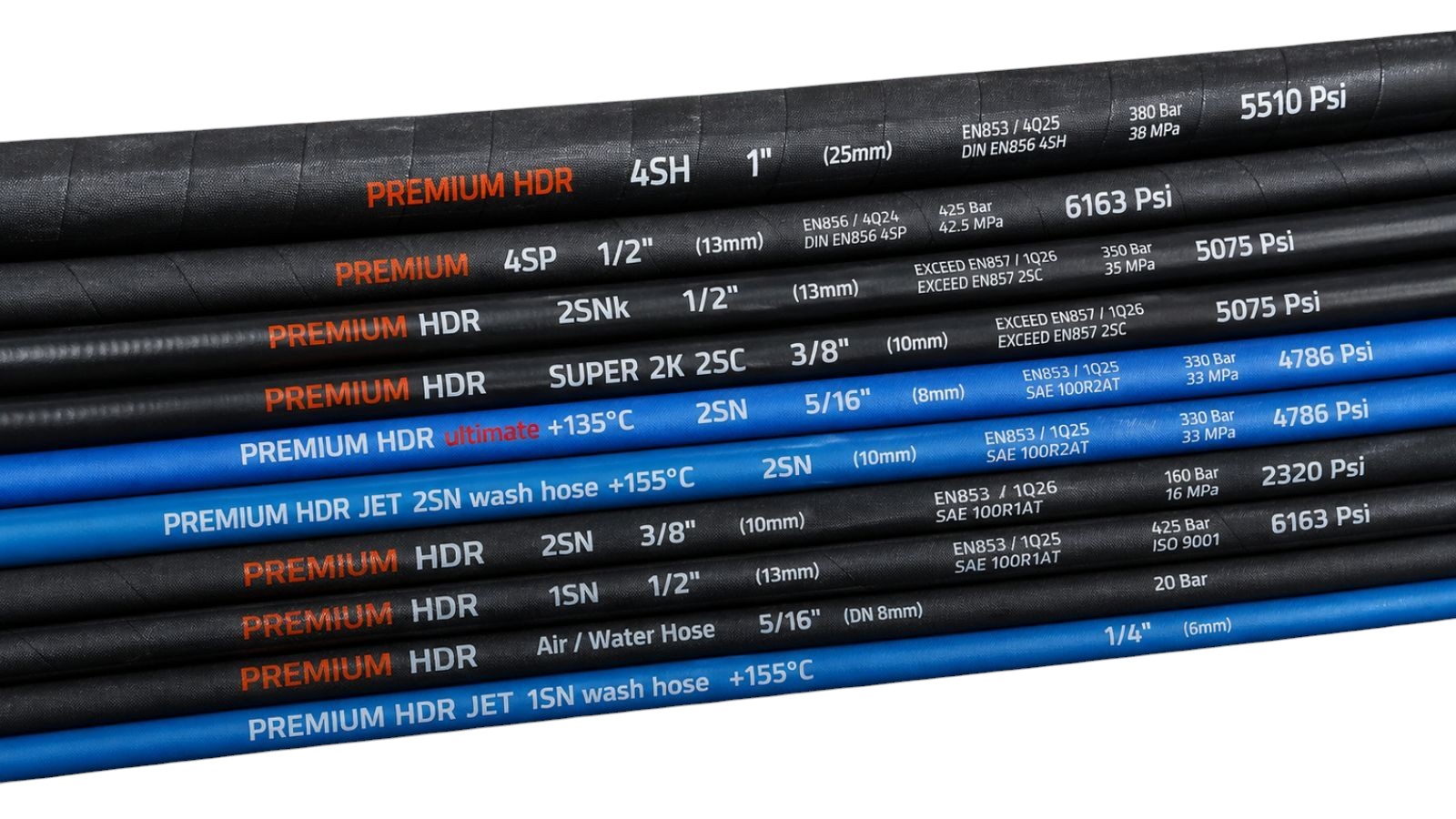
What is a hydraulic hose and what is it used for? A hydraulic hose is a flexible conduit used in power hydraulic systems to transmit working fluids under high pressure. Hydraulic hoses are components in systems where precise transmission of hydraulic energy is required - hence we also refer to them as power hydraulics hoses. Rubber hydraulic hoses are used in power hydraulic systems for power transmission and control. The primary medium they are intended for is hydraulic oil. Due to their construction, typical rubber hydraulic hoses can be divided into those with textile braids and those with steel wire braids. They operate in temperature ranges from -40 to +100°C and working pressures up to 420 bar. Hydraulic hoses consist of several layers: Inner layer – resistant to the working fluid, most often made of synthetic rubber. Reinforcement layer – provides resistance to high pressures, made of textile braid or steel spiral. Outer cover – protects the hose from mechanical damage and external factors such as abrasion or weather conditions. High-pressure hoses are designed to handle very high pressures. They are reinforced with steel wire or synthetic fiber to ensure strength and flexibility. High-pressure hoses find application in hydraulic systems such as in the construction, agricultural, power industries and many others.
High-pressure hydraulic hoses
We offer a wide range of hydraulic hoses, ideal for applications requiring the highest strength and resistance to high pressures. Our hydraulic pressure hoses have been designed to meet the requirements of modern hydraulic systems in various industries, such as industry, agriculture, and construction. The high-pressure hydraulic hose available in our offer is characterized by durability and resistance to damage, making it an ideal choice for the most demanding applications. Among the available models you will find 2SN hydraulic hose, which combines flexibility with pressure resistance, performing perfectly in a wide range of applications. Semperit hydraulic hoses and Vitillo hydraulic hoses are products valued for quality and longevity, meeting the highest industrial standards.
Silicone-free hydraulic hoses (LABS-free / PWIS-free)
At HYDRON, we also offer hydraulic hoses and industrial lines available with LABS-free / PWIS-free statement (Silicone-Free). This solution is intended for industries where even trace amounts of silicone can negatively affect painting processes and coating quality. If you want to learn what the LABS-free standard is, when it is required, and how to order lines with appropriate documentation.
Hydraulic hose by the meter
Hydraulic hoses by the meter. In the following category, you will find high-pressure hydraulic hoses cut to length, which are included in the offer of our power hydraulics shop. We have a continuous supply of hoses including 1SN, 2SN, 4SP, 4SH, 1SC, 2SC, high-temperature hoses, and many others. In case of any doubts regarding the choice, we invite you to contact the sales department. We deal in both retail and wholesale (power hydraulics wholesaler, rubber hose wholesaler ) We are a distributor for many recognized world manufacturers. Our offer does not only include hydraulic hoses and lines; we also offer industrial hoses (hoses for industry), which are used in practically every field and industry. Offered brands of pressure hoses intended for power hydraulics : PREMIUM class hydraulic hoses, SEMPERIT, ALFAGOMMA, PARKER, EATON, GATES, MANULI, SEL HOSES, EXITFLEX, POLYHOSE; STOMIL, M-FLEX, BALFLEX, NORTH FIGHTER
Hydraulic hose sizes
One of the basic parameters to consider when choosing a hose is its nominal diameter, denoted by the symbol DN (from the French Diamètre Nominal) What is the nominal hose diameter (DN)? Nominal diameter (DN) is a conventional value defining the internal diameter of the hose. In practice, DN is often given in millimeters and corresponds to the approximate internal diameter of the hose. For example: DN 6 corresponds to a diameter of approximately 6 mm, DN 12 is approximately 12 mm. It is worth noting that hydraulic hoses are often produced according to specific standards that specify their dimensions in inches. However, in the metric system, especially in Europe, DN designations in millimeters are commonly used. For example, a hose with a diameter of 1/4 inch will have the designation DN 6, and 1/2 inch is DN 12.
The most popular sizes of hydraulic hoses used.
Our offer includes a variety of sizes, such as: hydraulic hose 1/4 inch, 5/16 inch hydraulic hose, 3/8 inch, 1/2 inch hose, 3/4 inch hydraulic hose, and 1 inch hydraulic hose. Thanks to this diversity, you can precisely match the product to specific technical needs. Below is the designation in millimeters and the designation in inches + additional explanation.
- hose fi6 = DN06 mm hose = 1/4" how many mm = 6.35 mm
- hose fi8 = DN08 mm hose = 5/16" how many mm = 8 mm
- hose fi10 = DN10 mm hose = 3/8" how many mm = 9.53 mm
- hose fi13 = DN13 mm hose = 1/2" how many mm = 12.7 mm
- hose fi16 = DN16 mm hose = 5/8" how many mm = 16 mm
- hose fi20 = DN20 mm hose = 3/4" how many mm = 19/20 mm
- hose fi25 = DN25 mm hose = 1" how many mm = 25mm
- hose fi32 = DN32 mm hose = 1 1/4" ( 5/4 hose ) how many mm = 32mm
- hose fi40 = DN40 mm hose = 1 1/2" ( 1.5 inch hose, 6/4 inch ) how many mm = 38.1 mm
- hose fi50 = DN50 mm hose = 2" how many mm = 50.8 mm
Basic classification of hydraulic hoses:
- low-pressure hoses (e.g. fuel hoses, air, water )
- high-pressure hoses ( 1SN hydraulic hoses, 2SN hoses )
- multi-spiral high-pressure hoses, multi-braid ( 4SP hoses, 4SH hoses, R15 )
- additional classification of hoses by internal diameter
Classification of hoses by external surface
- Wrapped hydraulic hoses - wrapped hoses have a rough, textured external surface, which is often used in conditions where increased resistance to mechanical damage is required. The wrapped structure makes these hoses less prone to abrasion and scuffs, making them an ideal solution in harsh environmental conditions such as construction, agriculture, and heavy industry. Wrapped hoses are the most popular type of hydraulic hoses (1SN, 2SN, 4SP, 4SH)
- Smooth hydraulic hoses (Smooth Cover) - another type of hoses are smooth hoses, also called smooth cover, have an even and smooth external surface. These types of hoses are characterized by lower resistance when dragging and easier cleaning, making them popular in places where the hose may be exposed to contaminants and needs more frequent cleaning. The smooth surface also minimizes the risk of dirt accumulation and is less prone to dust and debris settling. This type is used, for example, in forklifts, bucket lifts, etc.
Hydraulic hose marking
How to interpret markings on hydraulic hoses? How to read the marking on hydraulic hoses? Marking of hydraulic lines according to DIN EN ISO / SAE and labeling. Principle: there are no unmarked lines – even for the service workshop needs. All hydraulic lines, whether intended for low, medium, or high pressure, should be permanently marked on the outer part of the hose: the markings we most often encounter are: manufacturer name / hose brand, working pressure, internal diameter of the hose, standard, production date (year, quarter, or month). Every hydraulic hose has markings that provide essential information about it. The most important include: ✓ Manufacturer and trade name: Inform about the manufacturer and the specific hose model. ✓ Hose type and number of braids: Markings such as 1SN, 2SN, 4SP, or 4SH indicate the hose construction and the number of reinforcing layers. For example, 1SN is a hose with one steel braid, and 4SP is a four-braid hose designed for high pressures. ✓ Hose performance standards: Hoses meet specific standards, such as EN 853 for single- and double-braid hoses or EN 857 for hoses with increased flexibility. ✓ Internal diameter (DN): Given in millimeters, e.g., DN16 means an internal diameter of 16 mm. ✓ Working pressure: The maximum pressure at which the hose can safely operate, expressed in bar, megapaskals (MPa), or PSI. ✓ Production date: Informs about the hose production time, which is important for its durability and service life.
Working pressure of hoses, chemical resistance
Working pressure of hydraulic hoses is the maximum pressure at which the hose can safely operate for a long time. Hose pressure varies depending on its diameter, reinforcement (number of braids). Proper selection of the hose for working pressure is crucial to ensure the safety and reliability of the hydraulic system, minimizing the risk of damage and extending the life of the installation. Correct selection of hoses: To correctly select a hose for a specific task, you can use the chemical resistance table for the materials the hoses are made of. Hose chemical resistance table for hydraulic hoses is a key tool for those involved in selecting the right materials for transporting chemical substances. The table indicates which materials are resistant to specific chemicals, facilitating the choice of hoses that will be effectively and safely used in a given application.
Hydraulic hose catalog
On this page, we present the hydraulic hose catalog, including the most popular models used in power hydraulics, pneumatics, and many other industries. Here you will find detailed information about hoses that stand out for high quality, durability, and wide use in demanding working conditions. In the catalog, you will find datasheets for the following hoses:
- datasheet for PREMIUM 1SN single-braid hose
- datasheet for PREMIUM 2SN double-braid hose
- datasheet for PREMIUM 2SNK reinforced hose
- datasheet for PREMIUM 1SC compact hose
- datasheet for PREMIUM 2SC compact hose
- datasheet for PREMIUM 4SP four-braid hose
- datasheet for PREMIUM 4SH four-braid hose
- datasheet for PREMIUM jet 1SN, 2SN pressure washer hoses
- datasheet for air and water hose
- datasheet for fuel, gasoline, oil suction and delivery hose
- datasheet for 25-125 rubber fuel, gasoline, oil hose
- datasheet for DN06-25 rubber fuel, gasoline, oil hose
- datasheet for rubber hot oil hose
- datasheet for stainless steel braided PTFE Teflon hose
Useful information regarding pressure hoses:
- working pressure of hydraulic hoses
- selection of hydraulic hoses and criteria for selecting hydraulic hoses
- production of hydraulic hoses - how the production process of hydraulic hoses looks like
- basic technical information about hydraulic hoses
- hose selection table for nominal working pressure of a hydraulic line
- visual inspection of hydraulic lines
- information on the correct storage of hydraulic hoses
- instruction for crimping hydraulic hoses
- guide - how to read markings on hydraulic hoses
- hose flow vs. its internal diameter
- where do hydraulic hoses and lines appear?
Types of hoses offered:
- industrial hoses offer
- high-pressure hydraulic hoses 1, 2, 4 or 6-braid (steel braided hoses)
- smooth hydraulic hoses (with a smooth external surface)
- hydraulic hoses with embossed markings instead of printed ones (embossed hoses)
- pressure washer hoses, hot water hoses up to +155C
- thermoplastic hoses reinforced with steel or textile braid
- smooth or corrugated PTFE Teflon hoses reinforced with stainless steel braid
- suction and delivery hydraulic hoses with diameter DN 20 - DN 102 (steel wire reinforced)
- PVC, metal, rubber hoses
- water, steam, and air hoses (pneumatic hoses, calibrated hoses)
- technical gas hoses (oxygen, acetylene, gas, LPG, CNG hoses and others)
- food substance hoses (food, milk, beer, and other hoses)
- oil and fuel hoses (gasoline, oil, diesel, dispenser hoses)
- extraction, ventilation hoses
- metal hoses (externally steel braided hoses, rigid hoses i.e. tubes)
- sandblasting and plastering hoses (shot blasting hoses, sandblaster hose)
- concrete hoses, gypsum, cement hoses
- chemical / chemical substance hoses (acid hoses, aggressive liquid hoses)
International standards for hoses, hydraulic lines
- ISO 17165-1 Fluid power: Hydraulic hoses and lines, specifications
- ISO 17165-2 / SAE J1273: Rubber hoses and lines, hydraulic applications
- ISO 8331: Rubber and plastics hoses and hose assemblies
- ISO 4413: 2011-4 Fluid power – General rules and safety requirements for hydraulic systems and their components
- SAE J 1273: Recommendations for working with hydraulic lines
- EN ISO 18752:2015: Rubber hoses and hydraulic lines, applications
- EN856 4SP, 4SH hoses
- EN854 rubber oil hoses
- SAE100R4
Pressure hoses
What is a pressure hose? A pressure hose is a flexible conduit used to transport various media (liquids or gases) under a specific pressure. Hoses of this type find application in many branches of industry – from power hydraulics, through the chemical and food industries, to agriculture and construction. They are characterized by high resistance to demanding working conditions, such as high pressure, extreme temperatures, or contact with aggressive substances. Thanks to their flexibility and reinforced construction, they can safely deliver the working medium where rigid piping would not be practical. Various types of pressure hoses are available on the market, adapted to different media and working conditions. For example, in the Hydron shop offer, you can find, among others, water, steam and air hoses, oil and fuel hoses, as well as specialized high-pressure hydraulic hoses. Each of these categories has its own construction and material specifics related to the hose's purpose. Below we present the characteristics of selected types of pressure hoses – hydraulic, water, and oil – discussing their structure, materials, and typical applications.
Types of pressure hoses:
There are many types of pressure hoses used in various industries and applications. These are just a few examples of types of pressure hoses. There are many other specialized hoses available depending on specific needs and applications. When choosing the right pressure hose, it is important to consider parameters such as working pressure, temperature, medium, working environment, etc. Below I present some of the most popular:
Rubber hose
Rubber hoses are widely used in various fields such as industry, agriculture, automotive, and many others. They are flexible, durable, and have good resistance to various factors such as oils, fuels, chemicals, etc. Depending on the needs, rubber hoses can be reinforced with fabric, steel wire, or synthetic fiber.
Thermoplastic hose
Thermoplastic hoses are made of high-strength plastics such as nylon, polyurethane, polyvinyl chloride (PVC), etc. They are lightweight, flexible, and characterized by good chemical resistance. Thermoplastic hoses are used in the chemical, food, medicine industries, etc.
Teflon hose
Teflon hoses, made of polytetrafluoroethylene (PTFE), are used in applications requiring resistance to high temperatures, chemicals, and chemical reagents. They are exceptionally smooth, which facilitates fluid flow. Teflon hoses are used in the chemical, pharmaceutical, food industries, etc.
Fuel hose
Fuel hoses are specifically designed for transporting fuels, oils, and petroleum-based substances. They are resistant to fuels, oils, ozone, and atmospheric conditions. Fuel hoses are widely used in the petrochemical, automotive, and transport industries.
Price of hydraulic hoses
The price of hydraulic hoses is attractive and has been calculated to offer you the best value for money. We ensure that every hose available in our range is a high-quality product that will meet the expectations of even the most demanding customers. We encourage you to check out the individual hose categories available on the following pages, where you can browse the full range of hydraulic pressure hoses and technical information. In our offer, you will surely find the ideal high-pressure hydraulic hose adapted to your needs.
Intended use of hydraulic hoses
Application of high-pressure hoses: High-pressure lines find application in many types of machines that require reliable transmission of liquids under high pressure. Here are examples of machines where they are commonly used: Excavators and loaders – hydraulic lines power the working arms and other hydraulic elements, enabling precise control, Cranes – used for operating lifts and booms that work under high load and pressure. Combines and tractors – in agricultural machinery, high-pressure lines drive hydraulic components, such as cylinders responsible for the movement of working elements, Hydraulic presses – hydraulic lines power the pressing cylinders, generating the very high pressures necessary for processing materials, Lifts and forklifts – lines are used for lifting and lowering loads, guaranteeing stability and precision, Drilling machines and drilling platforms – lines provide power to drilling tools, enabling effective drilling in difficult conditions, Concrete mixers and concrete pumps – used for transporting concrete mix over long distances under high pressure, Backhoe loaders and dozers – lines power the hydraulic systems responsible for the movement of blades and other working elements. Trucks with booms (e.g., HDS) – hydraulic lines enable lifting and lowering of loads, ensuring stable and safe operation, Industrial machines for forming and cutting – lines power forming and cutting tools that require precise pressure control, Recycling machines – hydraulic lines operate presses and material crushing machines, enabling their compression under high pressure.
Hydraulic lines by the meter
Hydraulic lines by the meter are a solution chosen wherever length flexibility, full quality control, and the ability to precisely match the hose to a specific installation matter. Hydron offers hydraulic hoses sold by the meter, intended for further crimping with fittings according to the requirements of a given application. This is a standard used in professional power hydraulics services, workshops, and production plants. By buying hydraulic lines by the meter, the user gets exactly the amount of hose needed, without compromises and without the need for unnecessary connections. This approach directly affects system reliability, aesthetics of workmanship, and safety of the hydraulic installation.
SAE 100R hydraulic hoses
Standard SAE 100R concerns technical specifications and requirements for hydraulic hoses used in power hydraulics systems. It is a standard developed by the organization Society of Automotive Engineers (SAE), which classifies different types of hydraulic hoses based on their construction, strength, working pressure, and application. Key information about the SAE 100R standard: Scope of application: Hoses meeting the SAE 100R standard are used in hydraulic systems where petroleum-based fluids, hydraulic fluids, and other compatible media are transferred. They find application in a wide range of industrial, agricultural, construction, and automotive applications. Benefits of certifying hoses according to the SAE 100R standard: Guarantee of quality and reliability in demanding applications. Standards allow users to choose the right hose for specific working conditions. Features of hoses defined by the SAE 100R standard: Construction: Each type of hose has a specific construction (number of braids, cover material, core, etc.). Working pressure: Depending on the hose class, the standard specifies the maximum allowable working pressure. Bending radius: The standard specifies the minimum bending radius that the hose can withstand without risk of damage. Temperature range: SAE 100R takes into account the resistance to a specific operating temperature range of hoses. Universal designation facilitates identification and hose selection.
The SAE 100R standard is divided into different types of hoses, depending on their construction and technical specifications. Each type has a different designation, e.g.:
- SAE 100R1 – Hoses with one steel braid.
- SAE 100R2 – Hoses with two steel braids.
- SAE 100R3 – Hoses with two textile covers.
- SAE 100R4 – Hoses for low pressure (e.g., hydraulic returns).
- SAE 100R5 – Hoses with textile reinforcement and an outer braid.
- SAE 100R6 – Hoses for low-pressure applications with textile reinforcement.
- SAE 100R7/R8 – Thermoplastic hoses for medium and high pressure.
- SAE 100R9/R12/R13/R15 – Multi-layer hoses for high pressure and intensive applications.