









Hydraulic adapters
Produkty z kategorii
Hydraulic adaptors - straight, elbows, tees
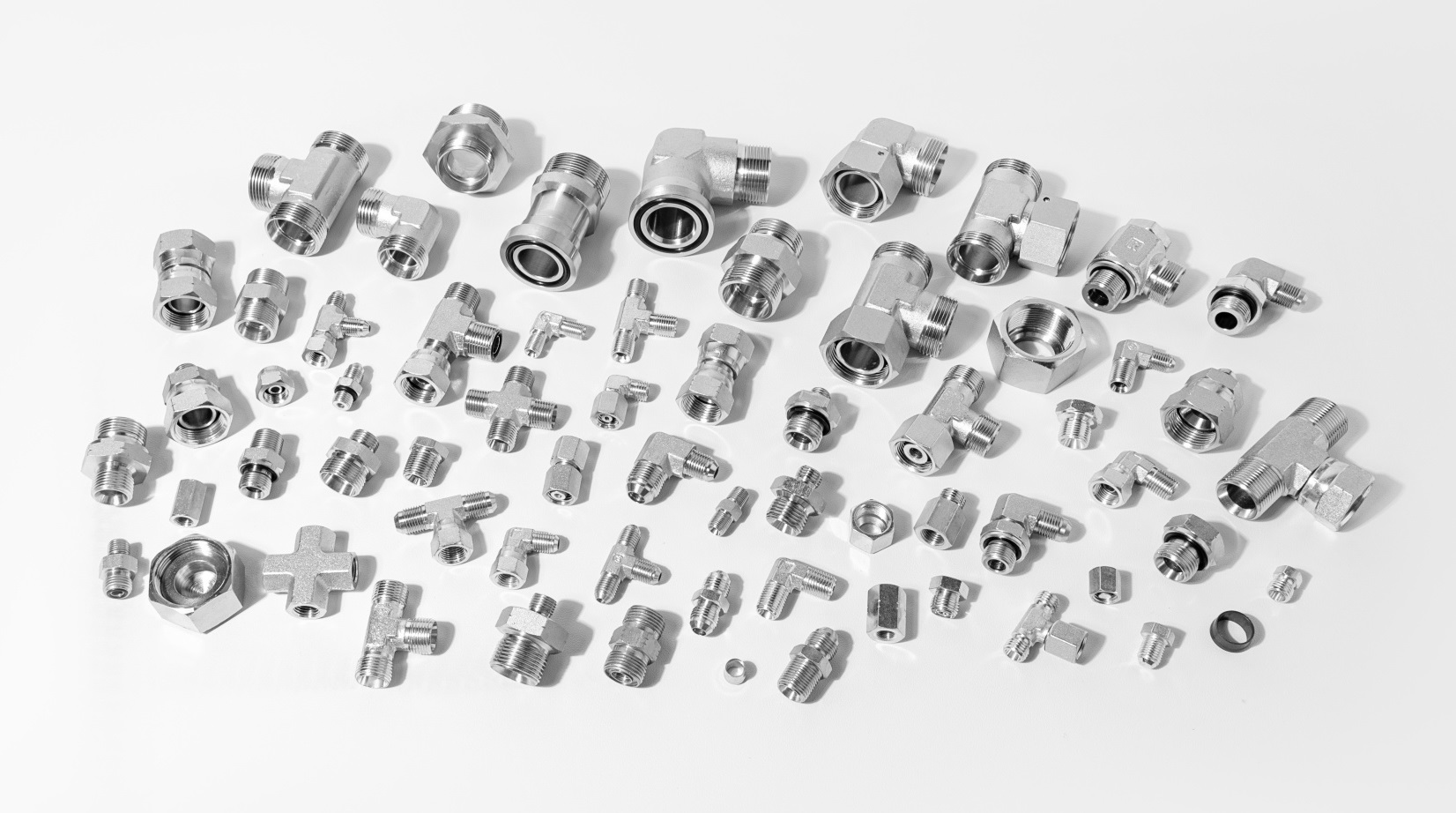
Hydraulic adaptors and connectors
Where are threaded fittings used ?
What for and where are threaded hydraulic connectors used ? Hydraulic connectors are essentially intended for: connecting hydraulic tubes ( by tightening with a ring and nut ) or as fittings for connecting hoses, hydraulic lines (by screwing onto the hose end) In our offer, we have both connectors for a cutting ring and nut (for connecting tubes commonly called compression fittings) as well as threaded steel with a cone and all types of hydraulic connections without a cone (to be screwed into a block, cylinder, valve, etc.) Available in various configurations: straight, elbow, elbow connectors, sockets, female connectors, adjustable, tee, cross, etc.
Hydraulic hose fittings. for connecting hydraulic lines
Fastening elements also appear under the name "hydraulic hose fittings". With fittings, we can not only connect a precision tube but we can also use them to connect 2 hydraulic hoses. As we know, hydraulic hoses are most often crimped with ends with a nut (internal thread). Using e.g., a straight fitting, we can connect 2 hydraulic hoses together - we screw the fitting into the thread existing in the hydraulic hoses. In this way, we can, for example, extend hoses. The connectors are called high-pressure connectors because they withstand up to several hundred bar. Detailed information on the working pressure of individual connectors can be found in the CERTIFICATES section. Connectors can be successfully used in medium and low-pressure installations. Manufacturing standards of fittings: ISO 8434; DIN 2353, SAE J514, ISO 6162, ISO 12151, ISO 1179, SAE J1453, DIN 7631, ISO 8431, ISO 9974, BS 5200; SAE J1231; ISO 8431-2. Hydraulic fitting manufacturer. Our company deals with the production and distribution of fastening elements used for transferring medium such as oil or air. Here you will find more information about connector production and their manufacturing technology.
High-pressure tube connectors - tube, pipe joiners
Hydraulic fittings appear under several names such as tube connectors (due to the fact that they can be used to connect high-pressure tube lines). We connect the connectors using a cutting ring and a union nut > hence the name "tube / hydraulic compression connectors". The name comes from the method of mounting fittings with a hydraulic tube, which does not require welding. We put a compression ring on the seamless tube and then a hydraulic nut, we apply the whole thing to the thread of the fitting and tighten until the compression ring is fixed on the tube (it tightens permanently).
Hydraulic tube connectors
Hydraulic fittings are also referred to as "Hydraulic tube joiners" - these are power hydraulics fastening elements that enable quick and durable connection of high-pressure tubes (seamless precision tubes) without the need for welding. Application and advantages of hydraulic tube connectors: Hydraulic tube connectors are intended for seamless high-pressure tubes, ensuring a tight and durable connection in high-pressure systems. The main advantage of using tube joiners is the elimination of the need for welding, which significantly speeds up the assembly and service of the installation. Using high-pressure tube connectors is an ideal solution for: ✔ Power hydraulics systems – in construction, industrial, and agricultural machinery. ✔ Heavy industry – e.g., in the mining, metallurgical, and energy sectors, ✔ Installations requiring high resistance to pressure and temperature. Thanks to the use of precisely made threads and seals, hydraulic tube connectors ensure maximum tightness at pressures of several hundred bar!
Hydraulic tube connection
Hydraulic tube connections are elements of every power hydraulics system, providing durable and tight joining of tube lines. Their task is to efficiently transmit the medium under high pressure, eliminating the risk of leaks and guaranteeing trouble-free operation of the installation. In the Hydron offer, you will find a wide range of hydraulic fittings, including flared, ring, flange, and compression fittings. We offer products made of high-quality materials such as stainless steel and carbon steel, ensuring resistance to high pressures and intensive operating conditions. Our tube connections meet industry standards and are compatible with various hydraulic systems, allowing for their versatile use in industrial, mobile, and power hydraulics.
Types of hydraulic tube connectors
In our assortment, various hydraulic connectors are available. Among them are, among others: Threaded connectors, fittings with cutting rings, nuts – for durable connection of tubes with various thread sizes and various thread types. Angled and tee, cross fittings – enabling a change in the direction of liquid flow. Adapters, reductions, and various types of hydraulic transition pieces allowing for the connection of elements with different thread standards
How to choose the right hydraulic fittings ?
The choice of the right hydraulic fittings should take into account several key factors: 1) ✔ Standard and norm – match the connectors to the current standards (DIN, BSP, JIC, ORFS) and the specifics of the system in which they will be used. 2) ✔ Thread type – metric, BSP inch, BSPT tapered, or American JIC thread – the choice depends on the standards adopted in a given installation. 3) ✔ Sealing method – 24° cone seal (DIN), 37° (JIC), or O-ring seal (ORFS) – each option has its advantages. 4) ✔ Material of manufacture – stainless steel, carbon steel, or brass – it all depends on the operating conditions and corrosion resistance requirements. 5) ✔ Working pressure – choose connectors adapted to the working conditions to avoid the risk of leaks or damage to the installation. It is worth noting that there are many types of threads used in hydraulics that are specific to certain industries, standards, or manufacturers. It is important to choose the right type of thread according to the requirements and specifications of the hydraulic system. Below we present some of the most popular types of threads used in power hydraulics:
Hydraulic nipple – what is it and what is its application ?
Hydraulic nipple is one of the basic terms for all types of elements such as fittings, hydraulic connections, i.e., connecting elements in hydraulic systems, used for connecting lines, hoses, and other hydraulic components equipped with internal threads. It is essential for building durable and tight systems that must withstand high working pressures, often exceeding 700 bar. Construction of a hydraulic nipple: A hydraulic nipple has a simple but extremely functional design that ensures easy assembly and reliability in use. It consists of several elements: 1) External threads – the nipple is equipped with two external threads (e.g., metric, inch, BSP, NPT), which allows for connecting lines or other hydraulic elements. 2) Hexagonal ring (part for the wrench) – placed in the central part of the nipple, it allows for secure tightening with a hydraulic or flat wrench, which facilitates installation even in hard-to-reach places. 3) Material of manufacture – hydraulic nipples are most often produced from galvanized carbon steel, which ensures corrosion resistance and high durability. In specialized applications, stainless steel is also used 5) Seals – some nipples are equipped with additional seals (e.g., made of NBR rubber, FKM/Viton) or are sealed by a tapered fit of the thread surfaces.
Types of hydraulic nipples
Depending on the application, hydraulic nipples come in various variants: ✔ Straight hydraulic nipple – standard connector for connecting two elements with internal threads of the same diameter, ✔ Reducer hydraulic nipple – enables the connection of two lines or elements with different diameters or threads, ✔ Threaded (tapered) nipple – used to provide better sealing in threaded connections (e.g., NPT),
Reducer hydraulic nipple
A reducer nipple is a special type of nipple that allows for the connection of elements with different diameters or threads. It is indispensable in situations when: hydraulic lines of different diameters need to be connected, thread incompatibility prevents direct screwing of elements, it is necessary to reduce or increase the cross-section of the line in the installation. In our offer, reducer nipples appear under the name of straight reducer fittings. The most common variants are metric reductions, BSP inch nipples, JIC or NPT, adapted to various standards used in power hydraulics.
Metric connectors DIN DIN 2353
Metric fittings according to the DIN 2353 standard are the most commonly used connections in Europe. Their main feature is a metric thread and a 24° cone seal, which ensures high tightness. They are available in three pressure variants: light (L), heavy (S), and very light (LL), so they can be adapted to various working conditions. These connectors are designed to withstand high pressures and dynamic loads. Assembly is relatively simple – thanks to the cutting ring, a solid connection is formed during tightening, which effectively prevents leaks. By choosing DIN metric connectors, you can be sure that your hydraulic installation will work trouble-free for a long time. Metric thread, also known as ISO thread, is the most commonly used in hydraulics. It is a thread with a symmetrical shape and a truncated pitch, which provides an accurate and secure connection. Popular metric threads are e.g., M12x1.5, M14x1.5, M16x1.5, M18x1.5, M22x1.5, M26x1.5, M30x2, M36x2 etc. Examples of metric thread fittings are e.g. straight metric fittings, examples of metric thread ends are e.g., DKL, DKOL, CEL ends
Inch connectors BSP – British
BSP (British Standard Pipe) connectors are widely used worldwide, but are particularly popular in Great Britain and Europe. Their characteristic feature is a cylindrical pipe thread (BSPP) or tapered (BSPT). If you see the marking "G" or "BSP"– it means a cylindrical thread, while "R" indicates a tapered thread. BSP fittings are valued for their versatility. They can be used in oil, water, and pneumatic systems. Versions with a tapered thread seal on the thread, which means that no additional seals need to be used, which significantly simplifies assembly. The advantage of this type of connectors is their high pressure resistance and high availability on the market. When choosing the right variant, it is worth paying attention to the material – in conditions requiring corrosion resistance, stainless steel will work best. In Poland, in the power hydraulics industry, this type of thread is marked as BSP. An example is 1/4" BSP. Example of fittings with BSP threads: straight inch fittings, BSP elbows. Example of ends with BSP thread are : DKR, AGR ends
JIC connectors, flared connectors in accordance with ISO 8434-2/JIC 37° J514
If you are looking for exceptionally durable and high-pressure resistant connectors, it is worth paying attention to JIC (Joint Industry Council) connectors, in accordance with the SAE J514 standard. Their key feature is a 37° cone seal, which ensures excellent tightness even under heavy loads. Thanks to their unique design, JIC connectors are resistant to shakes and vibrations, making them an excellent choice for applications in aviation, heavy industry, or power hydraulics systems. Their huge advantage is easy assembly – the lack of the need to use additional seals makes the installation quick and efficient. This solution is ideal for those who need solid and long-lived connections that will work in even the most demanding conditions. UNF (Unified National Fine) threads are used mainly in American hydraulics, hence these types of fittings are called American fittings. External JIC thread : Joint Industry Council (JIC) thread is a popular type of thread used in hydraulics. It is used in connectors that require a tight and durable connection. An example is 7/16-20 UNF.
ORFS connectors – connectors with flat seal
In high-pressure systems where even the smallest leak can be a problem, ORFS (O-Ring Face Seal) connectors, in accordance with the SAE J1453 standard, are a reliable choice. Their secret lies in a flat seal with an o-ring, which effectively prevents leaks. ORFS-type threaded connectors ensure maximum tightness and one of the highest pressure resistances. These are some of the tightest connectors on the market – thanks to the rubber o-ring, assembly is easy, and the connection is perfectly matched. What's more, ORFS connectors eliminate the need for Teflon tapes or additional seals, which significantly facilitates their installation. If you work in difficult conditions where resistance to pressure, vibrations, or variable temperatures is key – ORFS connectors will be the best choice. They are often used in the mining industry, heavy transport, and construction machinery, where absolutely tight connections are required. The O-Ring Face Seal (ORFS) thread is used in hydraulic systems that require high tightness. ORFS threads have an O-ring seal that ensures the hermeticity of the connection.
NPT connectors
Connectors with NPT threads: National Pipe Taper (NPT) thread is widely used in the United States for threaded connections. It has a tapered shape that provides tightness when the thread is tightened. NPT threads also have markings for sizes, such as 1/8" NPT, 1/2" NPT, etc.
Hydraulic elbows - definition, types
Hydraulic elbows are one of the most commonly used fastening elements in power hydraulics systems. Their task is to enable a change in the flow direction of the working medium, which is essential in systems where assembly space is limited or when lines must be routed at a specific angle. The colloquial name "hydraulic elbow" results from their characteristic shape – resembling a bent section of a tube or line, which facilitates the organization of the hydraulic system. Why are these elements called "hydraulic elbows"? The term "hydraulic elbow" comes from their characteristic structure, which resembles a bent human knee. This simple but illustrative term is widely used in the industry because it intuitively describes the function of these connectors – changing the direction of hydraulic fluid flow at a 45° or 90° angle. In practice, elbows are an indispensable element of any hydraulic system, allowing for the adaptation of lines to structural requirements and minimizing pressure losses. High-quality hydraulic elbows available at Hydron meet the highest standards of durability and tightness. Thanks to the extensive offer, you will find the right solution for your hydraulic system, regardless of the specificity of the application. Check our offer and choose the best hydraulic elbow for your system!
Types of hydraulic elbows
In the Hydron offer, there is a wide selection of hydraulic elbows adapted to various types of connections and applications. Depending on the type of thread, mounting method, and bending angle, we can distinguish several basic categories:
- BB elbows – threaded angled elbow fittings - One of the most popular solutions are BB elbows, which have threaded ends, enabling quick and durable assembly in hydraulic systems. They are used where it is necessary to use a durable angled connection in installations working under high pressure.
- BB bulkhead elbows – for mounting in partition walls -For applications requiring mounting through a partition or structural plate, BB bulkhead elbows are the ideal solution. They allow lines to be routed through machine housing walls or hydraulic distributors while maintaining connection stability.
- Elbow connectors – called connection elbows, intended on one side for connection in an element, e.g., a distributor, and on the other side for connection with a hydraulic hose.
- AB elbows – elbow with a swivel nut. This type of hydraulic elbows is called an adjustable elbow due to the fact that the swivel nut enables convenient positioning of the elbow.
- AA elbows – elbow with two nuts - this type of elbows is called a female elbow due to the two swivel nuts
Hydraulic reducer nipple
Hydraulic reducer nipples in the Hydron offer constitute an indispensable element of the wide range of hydraulic fittings available in our store. These are precise and durable elements that enable the connection of different parts of hydraulic systems with different diameters and thread types.
Types of hydraulic nipples
The offer includes various types of reducer nipples that allow for their application in many configurations and types of connections. Among them, there are available differential bushings, which enable reduction between two internal threads of different diameters. This solution is particularly useful during the modernization of installations or in situations where it is necessary to adapt a connection to a new hydraulic element. Another group of products is straight reducer connectors, which have two external threads of different dimensions. This type of nipples is used for connecting lines or hydraulic elements with different diameters or thread standards. Depending on the needs, versions with both metric and inch threads are available, including BSP, JIC, UNF, or NPT. This allows for creating connections between different types of installations, regardless of the adopted standard. The offer could also not lack straight reducer connections, which constitute a connection between a hydraulic device and a line or fitting of a different diameter. These connections are used in various types of hydraulic systems where it is necessary to transition between different sizes or types of threads. Their precise workmanship guarantees high tightness and pressure resistance, even in the most demanding working conditions.
Check also :
- types of power hydraulic connectors
- basic types of threads used in hydraulic fittings
- high-pressure hydraulics
- maximum working pressure of hydraulic fittings
Photo gallery


