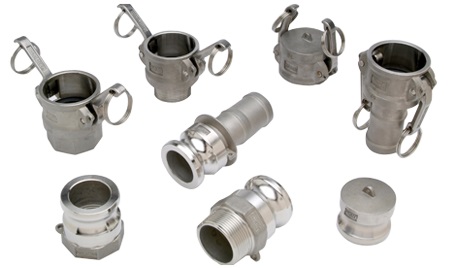
CAMLOCK Couplings
Produkty z kategorii
CAMLOCK Couplings
CAMLOCK is a group of connectors used, for example, in production, agriculture, oil, gas, chemical industries, and various industrial installations. It is an extremely versatile product, and because the system for connecting couplings is not based on threads, there are no issues with damage or contamination. This means that CAMLOCK couplings perform well in harsh environments where there is a lot of pollution or dirt, such as dust. The system is particularly suitable for situations requiring frequent hose changes, e.g., for tank vehicles, vacuum trucks, and the like. Camlock couplings are excellent for connecting and attaching hoses to pipelines. Individual Camlock products are manufactured from brass, polypropylene, 316 steel, and aluminum. The maximum working pressure depends on the coupling size and the type of material, ranging from 3 to 18 bar.
Applications of Camlock Couplings
In the chemical industry, Camlock couplings transport chemicals such as sulfuric acid. In the food industry, they are used in fluid transfer systems, for example, milk. In the oil sector, they connect hoses transferring crude oil and fuels. In agriculture, they play a key role in irrigation and fertilizer transfer. Thanks to their durability and ease of use, they also perform well in construction and fire departments. The variety of applications stems from the possibility of adapting them to the specific requirements of individual industries.
Benefits of Using Camlock Couplings
CAMLOCK couplings offer many benefits, including simplicity of assembly, which improves work efficiency. The solid construction ensures reliability and minimizes the risk of leaks. Corrosion resistance makes them suitable for use in various environments. These components are universal and suitable for transferring gases and liquids with different properties. A wide range of sizes and materials, just as in the case of cylinder seals and other products from our range, allows for easy matching to industry needs.
Materials Used in the Production of Camlock Couplings
Camlock couplings are produced from various materials, which affects their properties and applications. Our offer includes aluminum couplings. Aluminum is lightweight and corrosion-resistant, making it a popular choice. In turn, Camlock couplings made of stainless steel are characterized by greater durability and perform well in aggressive environments. Brass stands out for its high corrosion resistance and mechanical strength, making it ideal for high-pressure systems. Plastics, such as polypropylene, are primarily lightweight. The final choice of material depends on the specifics of the application and working conditions.
Camlock Coupling Sizes- Dimensions and How to Choose the Diameter for a Hose
Camlock dimensions are one of the most important parameters when choosing industrial quick couplings for transporting liquids, fuels, or bulk materials. In practice, the coupling diameter must be matched directly to the hose diameter, as it is responsible for the flow and efficiency of the entire system.
The most commonly used camlock diameters range from 1/2 inch to 6 inches, but in most applications, you will find:
- 1” – for light installations and workshop applications
- 2” – standard size in agriculture and liquid distribution
- 3” – higher flows, e.g., tanks and fuel transport
When choosing the right size, remember that the coupling diameter should correspond to the hose diameter. In practice, this means that a 2” coupling works with a 2” hose.
Gallery: