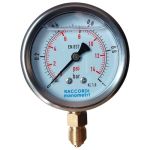
Pressure gauges are precision measuring devices used to monitor the pressure of liquids, gases, or steam in various industrial and technical systems. They are an essential element in systems where pressure control is crucial for safety and work efficiency. Bottom pressure gauges, also known as radial bottom connection pressure gauges, are characterized by the connection thread being located on the bottom of the device. This design facilitates installation in systems where the gauge must be positioned vertically.
What is a radial bottom connection?
A radial bottom connection is a construction element of the pressure gauge that allows for its vertical installation. The connection thread is located on the bottom of the housing, which allows for easy connection of the device to a pipeline or other hydraulic system. In the case of industrial pressure gauges, standard threads such as GZ 1/4" BSP are often used, in accordance with the EN ISO 228-1 standard, ensuring their universality and ease of integration with various systems.
Where are bottom pressure gauges used?
Bottom pressure gauges are commonly used in many industries, such as: Hydraulic and pneumatic industry – for monitoring pressure in hydraulic and compressed air systems. Energy – in steam systems and cooling circuits. Chemical and food industry – for pressure measurements in tanks, pipelines, and process installations. Workshops and technical services – in pneumatic systems of machines and devices. These devices are particularly effective in environments where shocks, vibrations, and variable atmospheric conditions occur. Glycerine filling additionally increases their durability, damping vibrations and protecting mechanism parts. Example gauge applications: pressure gauge for gas installation leak testing, oil pressure gauge ( hydraulic oil pressure measurement ), air pressure gauge.
Pressure gauge accuracy class 1.6
A pressure gauge with accuracy class 1.6 is a standard choice for most industrial and workshop installations where a reliable pressure measurement is needed without the need for expensive laboratory devices. The 1.6 designation informs that the maximum measurement error is 1.6% of the range value, which in practice provides sufficient accuracy for controlling the operation of a hydraulic or pneumatic system. In the category bottom pressure gauges such models are most commonly used in installations where the connection is from the bottom. This is a typical mounting in manifolds, power systems, or near tanks. Thanks to this, the pressure gauge is easy to install and clearly visible during machine operation. In practice, a pressure gauge with accuracy class 1.6 performs well in daily operation. It allows for quick assessment of whether the system is working correctly, or if pressure drops or overloads occur. It works with elements such as adapters for pressure gauges, which allow for thread matching, and with installation components like hydraulic valves or hydraulic directional control valves, where measurement is necessary.
This solution is simple and effective. It provides control over the system and allows for a response before a failure occurs.
What are the accuracy classes of pressure gauges
The most common classes are:
- 2.5 – basic accuracy, simple applications (e.g. general control)
- 1.6 – industrial standard, most commonly used
- 1.0 – higher accuracy, more demanding systems
- 0.6 – accurate technical measurements
- 0.25 / 0.1 – very accurate, control and laboratory applications
What does this mean in practice
If you have a 1.6 gauge with a range of 0–100 bar, the error can be at most ±1.6 bar.
For class 1.0, it will be only ±1 bar.
Which class to choose
In power hydraulics and pneumatics, the following are most commonly used:
- 1.6 – for daily work (machines, installations)
- 1.0 – when you need more precise control
- 2.5 – for simple, less demanding systems
To work with the installation, it is also worth choosing appropriate elements, e.g. adapters for pressure gauges or components from the category pressure and vacuum gauges, to ensure a fit for the system.
Characteristics of bottom pressure gauges from the offer
The pressure gauges available in the Hydron offer are distinguished by solid workmanship and compliance with international standards such as EN 837-1. Here are the most important features: Construction and materials: Housing: Made of AISI304 stainless steel, providing high corrosion resistance. Mechanism and connection: Made of brass and copper alloys, which guarantees reliability in contact with low-viscosity media. Filling: Glycerine, reducing vibrations and reducing mechanism wear. Sight glass: Made of plexiglass, resistant to mechanical damage. Measuring range: Available models offer various measuring ranges, suitable for constant, pulsating, and dynamic pressures. It is recommended to select a range so that the operating pressure does not exceed 75% of the maximum reading. Precision and reliability: Accuracy class: 1.6, which provides precise readings in industrial applications. Temperature resistance: Devices operate in ambient temperatures from -40°C to +65°C and media up to +60°C. Versatility: Connections in the GZ 1/4" BSP standard ensure compatibility with most installations.