










ENERPAC hydraulic pumps
Produkty z kategorii
ENERPAC hydraulic pumps
ENERPAC hydraulic pumps are advanced devices designed for maximum performance and reliability in various industrial applications. The offer includes manual, electric, pneumatic, and gas models, as well as modern cordless pumps. These versatile tools provide precise hydraulic pressure control and allow for work optimization in demanding environments. Thanks to high-quality craftsmanship and the use of innovative solutions, ENERPAC pumps are highly recognized in the industry.
700 bar hydraulic pump
Enerpac is a world leader in the production of high-pressure pumps, offering solutions for both professional workshops and heavy industry. In the Hydron range, you will find a wide selection of manual, pneumatic, electric, and battery-powered pumps tailored to various user needs. 700 bar pumps are devices used in high-pressure systems, ensuring the reliable operation of cylinders, hydraulic tools and other components requiring high power. Hydron offers Enerpac pumps that are characterized by the highest quality of workmanship and resistance to intensive use. 700 bar pump – how does it work and what is it used for ? A 700 bar pump is designed to handle hydraulic power systems requiring high operating pressure. It can be used in many industries such as heavy industry, construction, automotive, and technical services. Its primary task is to generate the pressure necessary for the operation of cylinders, cutting tools, jacks, or torque wrenches. The most common applications of 700 bar pumps include:
- Powering hydraulic cylinders in presses, jacks, and lifts.
- Supporting hydraulic wrenches and other bolting tools.
- Handling unloading, assembly, and testing systems.
- Application in mechanical workshops and repair services.
Types of ENERPAC hydraulic pumps
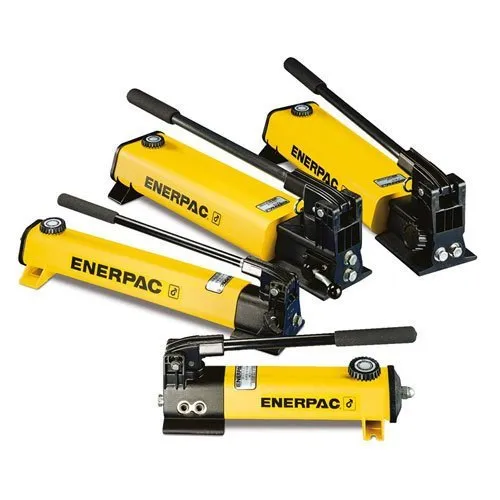
- Manual hydraulic pumps - ENERPAC manual pumps are lightweight and compact devices that are ideal for applications requiring mobility. They are characterized by simple operation, durability, and the ability to generate high pressures up to 700 bar. Examples of applications include lifting, clamping, or testing.
- Cordless battery-powered hydraulic pumps. Modern battery pumps from the XC series combine the convenience of cordless operation with high power. Equipped with lithium-ion batteries, they provide mobility and the ability to work in hard-to-reach places without the need for a connection to the electrical grid.
- Electric hydraulic pumps. Electric pumps from the E-Pulse® and ZE series are devices characterized by high efficiency and precise oil flow control. They are ideal for applications requiring high power and continuous operation in industry and construction.
- Pneumatic hydraulic pumps. ENERPAC pneumatic pumps are ideal solutions for environments where the use of electricity may be limited. They are characterized by reliability in difficult conditions and the ability to work in potentially explosive zones.
- Gas hydraulic pumps. Designed for applications in locations where there is no access to electrical or pneumatic power. These pumps provide independence and high power in remote locations.
- Controlled lifting pumps. Integrated with synchronous lifting systems, they allow for precise management of the multi-point lifting process, which is particularly useful in complex engineering operations.
- Pumps for torque wrenches. Specialized pumps designed to drive torque wrenches. They are characterized by high precision and efficiency, making them indispensable in applications requiring accuracy.
- Foot hydraulic pumps. Foot pumps are compact solutions for mobile applications. Their operation by foot allows for full freedom of hands during work.
- Accessories for hydraulic pumps. The accessories category includes supporting elements such as couplers, pressure gauges, or additional hoses that increase the functionality and range of pump applications.
- Repair kits for pumps. ENERPAC repair kits allow for independent maintenance and extension of the service life of devices, making them more economical over a long period of use.
Enerpac Pumps
High-pressure hydraulic pumps for industrial applications. We offer ENERPAC brand pumps. ENERPAC products are recognized worldwide for their high quality and durability. The pumps are used to drive high-pressure machines and devices such as: cylinders, cutters, spreaders, etc. We have most standard pumps directly in stock. Less popular products are available within a week, maximum two weeks from the order date. The most popular ENERPAC pump models are P142, P392. We have repair kits for practically every pump offered (sets of components that wear out during operation. We offer, among others, manual hydraulic pumps; foot hydraulic pumps; pneumatic hydraulic pumps; electric hydraulic pumps
Parts and accessories for ENERPAC hydraulic pumps
Hydron offers a comprehensive selection of ENERPAC pumps as well as spare parts and pump accessories that allow for maintaining the highest performance and reliability of the devices in any situation. Regardless of the pump type – manual, electric, pneumatic, or cordless – our offer includes everything you need for the maintenance, repair, and optimization of the devices' operation. Parts for all types of ENERPAC pumps. We have spare parts suitable for every type of ENERPAC hydraulic pump. Our offer includes, among others: hydraulic couplers, pressure gauges, high-pressure hoses, dust covers, seals, and piston elements. Each element complies with ENERPAC quality standards, which guarantees full compatibility and a long service life of spare parts.
Repair kits for ENERPAC pumps
Dedicated repair kits available at Hydron are the perfect solution for users who want to take care of their pumps independently. We offer repair kits dedicated to specific ENERPAC pump models, containing all necessary elements such as seals, rings, and other key components. This allows you to easily restore your pump to full efficiency, minimizing downtime and reducing operating costs.
What is a high-pressure hydraulic pump?
A high-pressure hydraulic pump is a device that generates and displaces hydraulic oil under very high pressure, allowing for the creation of enormous force with small dimensions. Thanks to this, it is the heart of many hydraulic systems, responsible for powering cylinders, presses, hydraulic wrenches, or other tools that must work with full power even in difficult conditions. Hydron offers Enerpac pumps, which have been considered some of the most reliable on the market for years. Their design allows for working pressures reaching up to 700 bar, providing exceptional performance and precision. High-pressure pumps stand out due to several elements that determine their effectiveness. The most important of these is the operating pressure, which in Enerpac pumps reaches a level unattainable for standard devices. Such high power allows for lifting heavy structures, driving long-stroke cylinders, or operating specialized tools without any problems. Efficiency is also significant, i.e., the amount of oil displaced per unit of time. In practice, this means that tools powered by the pump work faster and more efficiently. Many Enerpac models also have a two-stage operating system, which means that in the initial phase of work, the oil is supplied quickly at low pressure, and then the pump switches to high-pressure mode, allowing full power to be achieved with less operator effort. Another element worth noting is the type of drive. Depending on the needs, you can choose manual pumps – lightweight and mobile, ideal for simple field applications; electric pumps – ensuring uninterrupted work in workshops and industrial plants; and pneumatic or battery versions that combine convenience with high performance. Enerpac offers all these solutions, giving wide possibilities for selecting equipment for individual requirements. The oil tank is also important, as its capacity affects the duration and comfort of work. Enerpac manufactures pumps equipped with durable tanks made of materials resistant to damage and corrosion, making the devices suitable even for harsh industrial environments.
Application of high-pressure hydraulic pumps
High-pressure hydraulic pumps are used wherever high power and precision are needed. They are perfect for industrial systems for lifting and moving heavy structures, in workshops and production plants for powering hydraulic presses, as well as in the energy, petrochemical, mining, or construction industries where reliability and safety are required. High-pressure pumps are also frequently used in service work – e.g., when operating hydraulic bolting wrenches – and in mobile field activities where manual or battery-powered pumps prove useful.
Why choose an Enerpac pump at Hydron?
By choosing to purchase a high-pressure hydraulic pump at Hydron, you gain not only access to original Enerpac pumps but also professional advice in selecting the right model for your needs. Our specialists help determine the required pressure, performance, and drive type so that the pump works perfectly with your cylinders or tools. Additionally, we offer fast lead times, quality certificates, and after-sales support that ensures the equipment will serve without failure for a long time. A high-pressure hydraulic pump is an element of hydraulic systems that allows for achieving enormous power and precision in working with cylinders and tools. Enerpac brand models, available at the Hydron store, combine modern design, high efficiency, and reliability confirmed by many years of the manufacturer's experience. If you are looking for a solution that ensures maximum effectiveness and safety, choosing an Enerpac pump at Hydron will be the best investment.
How to select a hydraulic pump? A practical guide
Selecting the right hydraulic pump is a key stage in designing a hydraulic system – the performance, system lifespan, and work safety depend on its correct choice. Below you will find step-by-step what parameters are worth considering and how to match a pump to a specific application – using the dimensions and variants of Enerpac pumps that you can find in the Hydron offer.
1. Determine required operating and maximum pressure
The first step is to establish what maximum pressure the pump must provide to power all elements of the system – cylinders, actuators, valves, hydraulic tools. The pump must be able to reach at least this pressure. It is best to choose a pump with a safety margin (e.g., 10–20% higher) relative to the system requirements. In the Enerpac catalog, you will find pumps operating at high pressures — many models are adapted to work up to 700 bar (approx. 10,000 psi).
2. Calculate required oil flow / performance
After pressure, it's time for flow: how much oil must the pump deliver per unit of time for the system to work effectively? The flow must be adapted to the total volume of oil needed in the moving parts of the system and their cycle frequency — the larger the volume to be driven, the higher the flow. Enerpac provides pump selection guides that take into account the oil capacity of cylinders and the corresponding pump performances.
3. Pump variant: manual, electric, pneumatic or engine-driven
Depending on the application and installation conditions, the pump can be manually operated, electrically driven, powered by compressed air, or by a pneumatic/combustion engine. Manual pumps – a good option for mobile devices or service maintenance; Electric pumps – for stationary applications where access to power is easy; Pneumatic / air – when there is compressed air in the plant and automation is required. Enerpac offers various models in all these versions, which increases the flexibility of selection for a specific application.
4. Use of a two-stage (2-speed) construction
In many cases, it is worth considering two-stage (2-speed) pumps, which allow for fast "approach" at low pressure and then switch to high-pressure mode to perform the task. Thanks to this, the operator avoids a large number of handle strokes, and the work proceeds faster and more comfortably. Enerpac indicates that two-stage pumps can reduce the number of operating cycles by up to 78% compared to classic single-speed models.
5. Selection of materials, seals, and construction
The working environment (chemicals, moisture, temperature) requires matching materials and seal material. Furthermore, the pump should be resistant to vibrations and mechanical loads — important for the durability of the installation. For Enerpac products, materials and seals adapted to high operating requirements are used.
6. Check the Duty Cycle and intended use of the pump
If the pump will work continuously for a long time (e.g., in a production line), it must be adapted for continuous duty. For occasional applications, intermittent cycle models are sufficient. Enerpac highlights these differences in its selection guides.
7. Protective features and safety
A good hydraulic pump should be equipped with a safety valve (relief or check valve) that protects against overpressure. Choosing an Enerpac pump means access to models with appropriate valves or the possibility of their installation.
8. Compatibility with the receiver / hydraulic tool
The pump should be well matched to the tool, cylinder, or device with which it will work. Incompatibility of parameters can result in overloading, excessive wear, or loss of efficiency. Enerpac publishes matching tables for pumps and cylinders to facilitate this process.
9. Practical notes — installation, access, and maintenance
Make service easier — choose models that are easy to operate and have access to consumable parts. Ensure proper oil filtration — contaminant particles shorten the life of the pump and the entire system. Take care of vibration protection and proper mounting — so that harmful stresses for hydraulic components do not occur.
Pumps for power hydraulics
A hydraulic pump is a fundamental element of any hydraulic system, responsible for generating oil flow under pressure, which then drives cylinders, hydraulic motors, and other energy receivers. Its task is to convert mechanical energy (e.g., from an electric motor, combustion engine, or manual drive) into hydraulic energy, making it possible to perform work – lifting, moving, pressing, or rotating machine parts. In practice, hydraulic pumps are used wherever high force is needed with compact system dimensions. They are found in construction, agricultural, and industrial machinery, as well as in presses, jacks, hydraulic tools, and hydraulic power supply systems.
Hydraulic pumps are divided into several main types, depending on the principle of operation:
-
Gear pumps – most commonly found, durable and simple in construction, ideal for standard operating systems;
-
Piston pumps – provide high efficiency and precision, used in systems with high pressure and variable flow;
-
Vane pumps – characterized by quiet operation and good efficiency at moderate pressures;
-
Two-stage pumps – equipped with two displacement stages (fast and pressure), combining high operating speed with high working force.
The Hydron offer includes hydraulic pumps from renowned manufacturers such as Enerpac, which stand out for their high-quality workmanship, resistance to overloading, and precise pressure regulation. Both manual pumps, ideal for service applications, and electric and pneumatic pumps, designed for stationary work or in automated systems, are available.
Manual pump
A manual pump is one of the most universal devices used in power hydraulics. Thanks to its simplicity and independence from energy sources, it is excellent for field work, mobile services, and situations where precise pressure control is required. Models available at Hydron, including Enerpac manual pumps, ensure high work comfort and stability of parameters even under heavy loads. The design based on manual pumping allows for very high operating pressures with minimal user effort, making them an ideal choice for operating cylinders, crimpers, and specialized tools.
Classification of hydraulic pumps
The classification of hydraulic pumps results from the variety of applications, the method of generating pressure, and the construction. The most popular group consists of manual pumps, chosen where mobility counts. The second category is electric pumps – fast, efficient, and created for continuous work, often used in production, heavy industry, or when operating Enerpac high-pressure tools.
Operation of a hydraulic pump
The operation of a hydraulic pump is based on converting mechanical energy into hydraulic energy. The pump takes oil from the tank, generates high pressure in it, and directs it to the tool or cylinder. The entire process must run smoothly, which is why the construction of the working elements is of great importance – they determine the efficiency, flow stability, and effectiveness of the pump. By choosing an Enerpac pump, Hydron customers receive a guarantee of operation without sudden pressure drops and oil losses, which is particularly important for precision operations.
Hydraulic pump operating principle
The hydraulic pump operating principle involves cyclic oil suction and its displacement under increased pressure. The pump mechanism creates a vacuum that allows oil to enter the working chamber, and then the driving elements displace the liquid into the pressure lines. This process occurs continuously, and its effectiveness depends on the quality of workmanship and the type of drive used. In manual pumps, the drive is a lever, while in electric pumps – a motor with precisely selected power. Enerpac uses technologies that minimize energy losses and ensure exceptional efficiency, even during long-term operation under load.
Operating principle of a hydraulic pump
The operating principle of a hydraulic pump is common to all its types, but individual designs differ in the way they achieve flow. In piston pumps, a single piston or a set of pistons works, in gear pumps, the oil is moved by cooperating wheels, and in vane pumps, pressure is created thanks to the movement of vanes in the rotor. The variety of construction allows the device to be matched to specific working conditions – from light workshop applications to intensive tasks in industry. Hydron, as an experienced distributor, advises customers on choosing the construction that best meets their needs.
Hydraulic pump parameters
Hydraulic pump parameters directly translate into its capabilities and range of applications. The most important are the maximum pressure value, oil performance, and tank capacity. A pressure of 700 bar is a standard in Enerpac pumps and allows for handling the most demanding tools. Performance determines how quickly the cylinder will extend or retract, while the tank capacity affects the working time without the need to refill the oil. In multi-stage pumps, especially manual and electric ones, the first phase of work is responsible for fast flow, and the second for achieving high pressure. Thanks to this, the user receives maximum efficiency and comfort of use.
Construction of a hydraulic pump
The construction of a hydraulic pump includes a body, a working system, a tank, control and safety valves, and connections. Depending on the pump type, differences may occur in mechanical designs, but the principle remains the same – to ensure stable, safe, and as effective pressure generation as possible. Enerpac pumps stand out for the use of precisely made elements and high-quality metal alloys, which translates into wear resistance and a long service life of the devices. Hydron offers a wide range of pumps with various constructions, enabling the selection of a model precisely tailored to the working conditions.
Hydraulic drive pump
Hydraulic drive pump uses an external source of hydraulic energy to generate additional pressure and flow. This solution is most often used in industrial machines, specialized vehicles, and multi-circuit installations. Such pumps allow for increasing the system's capabilities or providing an independent high-power circuit. Due to their design, they stand out for high efficiency and stable operation even with complex hydraulic systems where precise control of individual elements is necessary.
Selection of a hydraulic pump
The selection of a hydraulic pump requires analysis of many factors: from the type of tool, through the required performance, to the working conditions. An improperly selected pump can cause slow cylinder operation, excessive oil heating, and even a risk of damage. Hydron, with nearly 20 years of experience and a wide range of Enerpac pumps, provides professional technical advice. Each customer can count on an analysis of working parameters, selection of compatible hoses and couplers, and technical support during the installation and operation stage. This is particularly important in industries where safety and high reliability count.
Hydraulic pump repair
Repairing hydraulic pumps is a process that requires a lot of experience, precision tools, and access to original spare parts for hydraulic pumps. Devices working under very high pressures, such as Enerpac pumps, must be serviced only in places that guarantee full safety and compliance with the manufacturer's standards. Hydron is an authorized Enerpac service center, which means we have the appropriate technical facilities, trained personnel, and certified handling and diagnostic procedures. We perform professional warranty and post-warranty inspections, seal replacements, adjustments, pressure tests, and full device diagnostics. Thanks to this, every repaired pump regains factory parameters and can work safely and reliably for subsequent years.
Hydraulic cylinder pump
A hydraulic cylinder pump is a fundamental element of the power hydraulic system, whose task is to generate the appropriate operating pressure and power actuators and hydraulic cylinders. These types of pumps are used wherever it is necessary to precisely and safely transfer large forces, both in industrial, service, and assembly applications. Without a properly selected pump, the work of a hydraulic cylinder would not be possible. Hydraulic pumps, including Enerpacbrand pumps, are used directly to power actuators and hydraulic cylinders with high-pressure oil. This allows for lifting, spreading, pressing, positioning, or moving heavy elements with full control over the force and piston stroke. The hydraulic cylinder pump is responsible for generating pressure, which then translates into the real working force of the system.
In practice, hydraulic cylinder pumps are used, among others, in hydraulic presses, jacks, assembly systems, steel structures, machine services, railways, power engineering, and heavy industry. They power both single-acting actuators and double-acting cylinders, depending on the pump's construction and purpose. Proper matching of the pump to the cylinder parameters has a direct impact on the safety and efficiency of the entire system.
Hydraulic cylinder pumps can come in various variants, such as manual pumps, foot pumps, electric pumps or pneumatic pumps. Each of these types finds application in different working conditions and allows for an optimal match of the solution to the specific user needs. High-class Enerpac hydraulic pumps are designed with intensive use, stable operation under high pressure, and a long service life of components in mind.
Gallery

expand text What is a hydraulic power unit ?
What is a hydraulic power unit?
A hydraulic power unit is a device that is the heart of every power hydraulic system. Its main task is to generate and deliver oil under the appropriate pressure to drive cylinders, motors, and other functional elements. The power unit combines the functions of a hydraulic pump, a tank, filtration systems, and safety systems, creating a complete hydraulic energy supply system. In practice, a hydraulic power unit is an irreplaceable solution where high power, precision of operation, and reliability are needed.
Construction and characteristic features of hydraulic power units
A typical hydraulic power unit consists of:
- a hydraulic pump – responsible for creating the flow of the working fluid,
- a drive motor – electric, combustion, or pneumatic,
- an oil tank – providing the appropriate amount of working medium,
- a control system and valves – controlling the pressure, direction, and flow rate,
- filters – protecting the system from contamination.
Thanks to its compact design and modern safety features, hydraulic power units work stably and safely and are adapted for intensive use.
Application of hydraulic power units
Hydraulic power units are used in many industries, including:
- in heavy industry and production,
- in construction and road machinery,
- in workshop and service devices,
- in lifting, clamping, and cutting systems,
- in specialized machinery, e.g., presses or assembly lines.
Their universality makes them used in both large industrial installations and in mobile machinery and tools.
Enerpac hydraulic power units – reliability in practice
The Hydron range includes Enerpac hydraulic pumps and power units, which have enjoyed a global reputation for years. Products of this brand are characterized by high performance, resistance to extreme working conditions, and a long service life. Thanks to a wide range, it is possible to choose the right solution – from manual pumps, through electric and pneumatic units, to advanced power units designed for work in demanding applications.