










Two-way ball valves
Produkty z kategorii
Two-way shut-off ball valves
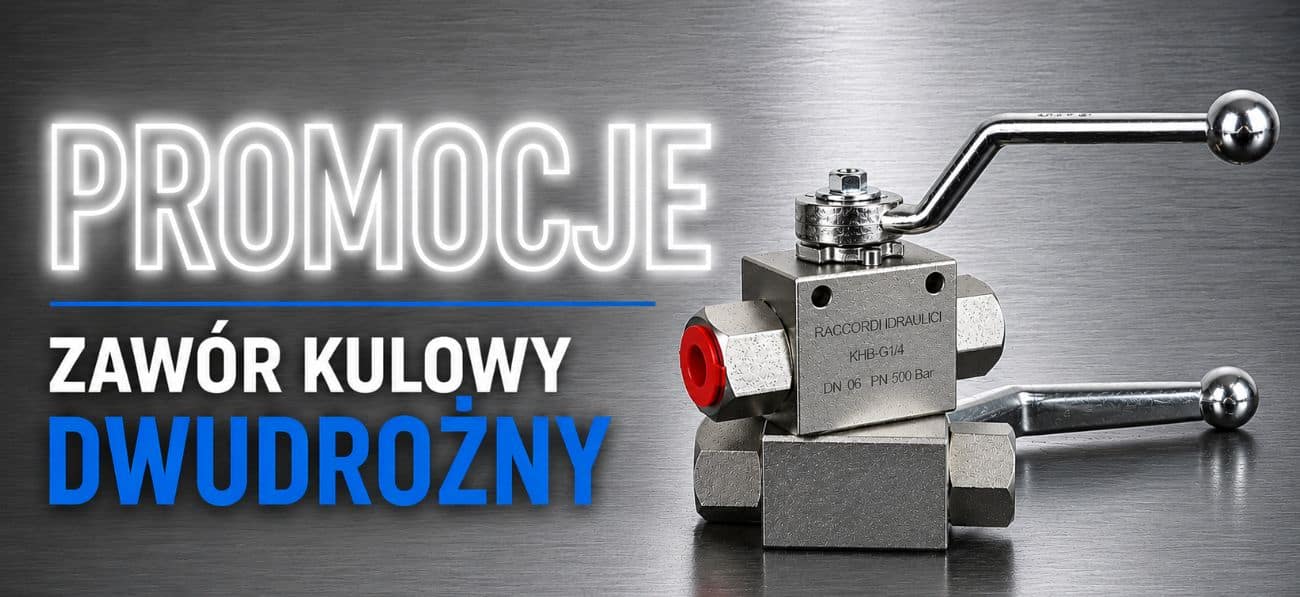
Two-way hydraulic high-pressure ball valves - shut-off valve power hydraulics
Ball valve, construction, operation, advantages
A valve is a type of valve used to control the flow of media in hydraulic, pneumatic or other transmission systems. The main task of a shut-off valve such as a ball valve is to close the flow of the working fluid. A key element of a ball valve is a rotating ball with a through-hole, which allows opening, closing or regulating the flow. Advantages of ball valves: Fast action – a 90° rotation allows for instant closing or opening of the flow. Tightness – high precision of seals minimizes the risk of leaks even at very high pressures. Resistance to pressure and temperature – suitable for operation in various conditions. Versatility – they can be used for various media, such as water, fluids, hydraulic oils, gas, chemicals.
Shut-off valve, ball valves as shut-off valves
A shut-off valve is an element of a hydraulic system whose task is to quickly and effectively cut off the flow of fluid in the system. Thanks to a simple and reliable design, shut-off valves allow for full control over the flow of the medium, which is essential in many situations – both during maintenance and in emergency situations. The use of shut-off valves allows for increased safety and facilitates hydraulic system management. Our offer includes two-way ball valves, which are perfect in the role of shut-off valves. Thanks to the use of a ball closing mechanism, they provide: Fast flow closure: Moving the lever to the closed position immediately blocks the flow of fluid. Tightness in both directions: The valve design guarantees no leaks, even at high pressure in the system. Simple operation: An intuitive lever allows for easy and quick valve control.
Construction of ball valves
Ball – made of metal or plastic, has a central hole that allows for the flow of the medium. A 90° rotation of the ball changes the state of the valve: Open – when the hole is in line with the flow of the medium. Closed – when the hole is perpendicular to the direction of flow. Valve housing – protects the ball and ensures tightness, usually made of steel, brass, stainless steel or plastic. Seals – guarantee the tightness of the valve, protecting against leaks. Lever ( handle ) – a manual mechanism enabling quick opening and closing of the valve.
Types of ball valves
Valves are available in several versions :
- with a mounting hole ( we offer these )
- without a mounting hole.
- valves with metric, inch BSP threads
- valves with internal, external threads
Valve sizes
Valves are available with many threads, metric, inch, NPT. Among the most popular sizes, we can indicate :
- Metric threads: M10, M12, M14, M16x1,5, M18x1,5, M22x1,5 itd.
- Inch BSP threads : 1/4", 3/8", 1/2", 3/4", 1", 1 1/4", 1 1/2", 2".
Application of shut-off valves :
Ball valves are widely used, among others, in:
- water and heating installations.
- power hydraulic systems.
- gas installations.
- chemical and petrochemical industry.
- transport systems for liquids and gases.
High-pressure ball valves
The valves we offer are intended even for several hundred bars. They can be successfully used in low, medium and high-pressure installations. Two-way ball valve is used to open or close the flow in a hydraulic system. The valve is operated using a handle - controlling the valve means closing or opening the flow of oil, liquid or gas. The action itself does not require too much force. Operating the valve is possible even at high pressure. Operating temperature: -30°C to 100°C. execution : galvanized steel.
Ball valves with external metric threads
This type of valve is found mainly in agriculture where standard threads are M18x1,5 , M22x1,5 metric threads. The valves are found in all types of machines and devices.
Valves with internal inch threads
The most popular type of valves. The valves have internal threads so it is possible to reduce it to any other thread . just select the appropriate fitting, which is screwed into the valve, and any other thread is obtained, e.g., metric, inch, jic. This type of valve is the most commonly found.
Stainless steel ball valves
Hydraulic valves made of stainless steel. Acid-resistant ball valves are most commonly found in all types of industrial installations. Used for aggressive liquids, e.g., acids, food and other demanding media. The most durable type of valves and at the same time the most expensive - up to several times more expensive than standard steel valves.
Oil ball valves
In power hydraulic systems, where the working medium is hydraulic oil, ball valves perform an important function – they allow for quick and safe opening and closing of the flow. Their simple, yet very effective construction makes them indispensable in many types of installations, both industrial and mobile. What are oil ball valves ? Ball valves are mechanical fitting components that enable manual or automatic control of the medium flow in a line. Their basic working element is a ball with a bore, which by rotating 90 degrees, opens or closes the flow of fluid. In the case of valves used in power hydraulics, the construction must be adapted to work under high pressure and for contact with hydraulic oils. For this reason, the ball valves offered by Hydron are made of high-quality galvanized steel or stainless steel, resistant to corrosion and aggressive working environments.
Application of ball valves in oil installations
Oil ball valves are used wherever it is necessary to control the flow of the working fluid. Example applications include: hydraulic systems in construction and industrial machinery, oil installations in power units and pumping stations, lubrication systems and oil filtration systems, service and shut-off points in high-pressure installations. They are also used at service points, where quick flow shut-off is key for installation safety and maintenance.
Certified hydraulic valves
Product name : Hydraulic ball valves ( metric threads ) RACCORDI IDRAULICI Type : BKH two-way ball valve
Type : BK3 three-way ball valve
The above products meet the standards : PN-EN ISO 8434-1:2010 - metallic tube connections for fluid power and pneumatic systems and general use ( 24 degree cone angle connectors )
Hydraulic valves with metric threads
Two-way hydraulic valves and three-way hydraulic valves with a 24° cone angle made in accordance with technical documentation, intended for use in hydraulic systems, for high-pressure connections and in hydraulic installations of other machines and equipment. Valves made of steel, galvanized - chromate passivation type A; free of Chromium (VI) in accordance with the DIN EN 15205 standard. Valves compatible with the 24° cone seat according to standards PN-65/M-73140, PN- 65/M-73141, DIN 3901, DIN 3902.
Hydraulic valves with BSP threads
Two-way and three-way hydraulic valves with a 60 cone angle° with inch (BSP) threads made in accordance with technical documentation, intended for use in hydraulic systems, for high-pressure connections and in hydraulic installations of other machines and equipment. Valves made of steel, galvanized - chromate passivation type A; free of Chromium (VI) in accordance with the DIN EN 15205 standard.
BKH Valves
BKH valves is a common term for hydraulic ball valves with internal threads on both sides (IT/IT). The abbreviation BKH originates from German naming Ball Kugelhahn Hydraulik and is commonly used in power hydraulics, pneumatics and industrial installations. What are BKH valves ? A BKH valve is a manual shut-off valve, in which the closing element is a ball with a through-hole. A 90° rotation of the lever causes full opening or closing of the medium flow. Internal threads on both sides allow for direct screwing of the valve into the system or connection with hydraulic fittings. What are BKH valves used for ? BKH valves are used wherever a fast and reliable flow shut-off is needed: in power hydraulic systems (hydraulic oil), in pneumatic installations (compressed air), in central lubrication systems, in agricultural, construction and industrial machinery, as service valves before distributors, actuators or filters. How to recognize a BKH valve ? If the valve: is a ball valve, has a manual lever, has two internal threads (e.g. BSP or metric), then in practice it is precisely a BKH-type valve. Construction materials of valves : The most commonly found BKH valves are made of: carbon steel – for power hydraulics, stainless steel – for aggressive media and difficult conditions, Ball seals are usually made of NBR, PTFE (teflon) or Viton, depending on the medium and operating temperature.
Key features of BKH valves
Valves of this type are valued for their simple yet very durable construction. They are characterized by: full or reduced bore, high tightness thanks to ball seals, resistance to high working pressure, the possibility of working in a wide range of temperatures, easy operation and fast action (open/closed).