










VRF check-throttle valves
Produkty z kategorii
VRF CHECK-THROTTLE VALVES
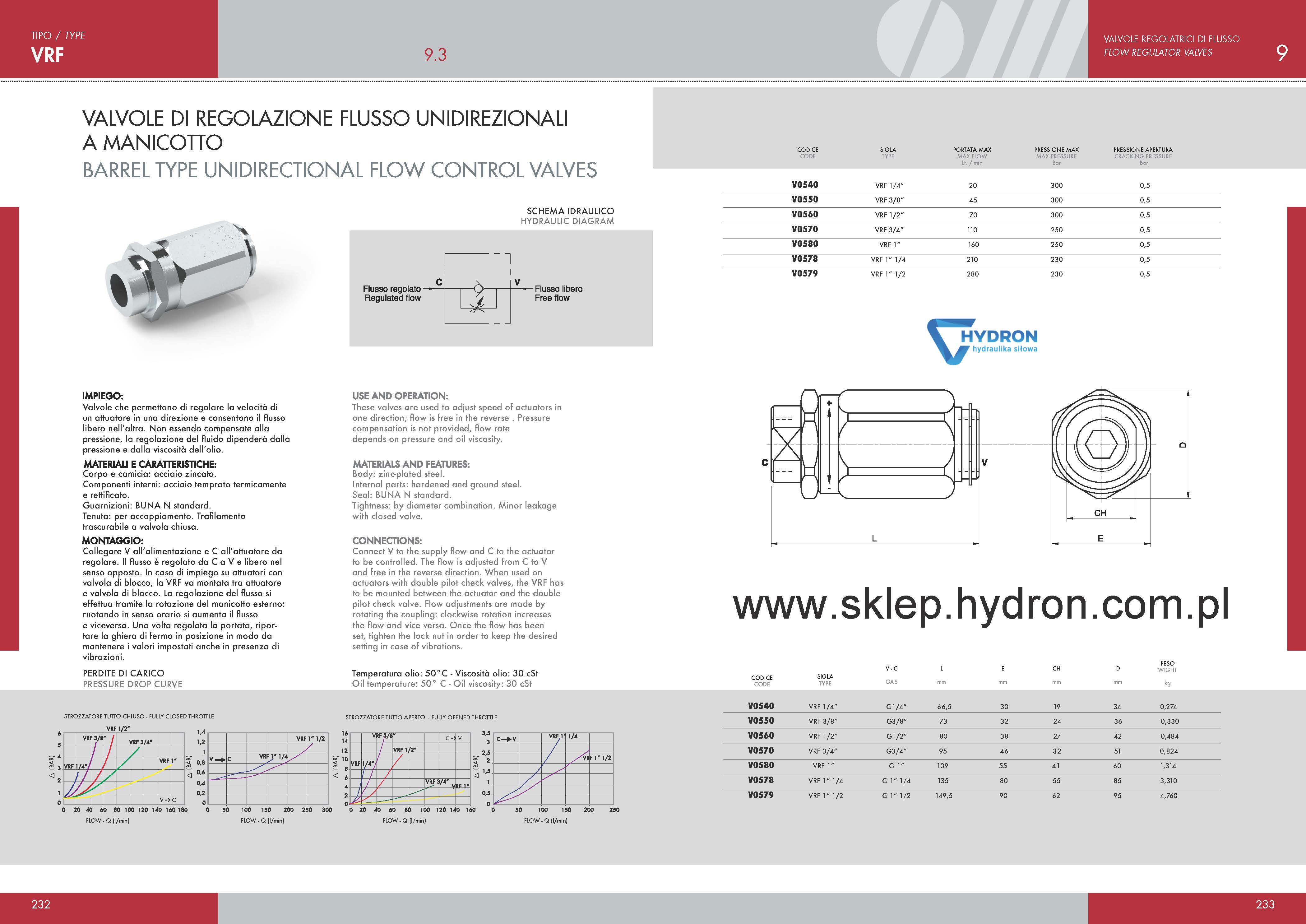
VRF barrel valves with adjustment - this type of valve throttles the flow in one direction. internal inch threads ( British ). Thanks to the internal inch threads, we have the possibility to screw in any fitting and in this way we can switch to any other thread: metric, inch, American. How to set these types of valves? Setting the throttling (level) is done by screwing and unscrewing both parts of the valve. The valve setting can be secured with a locknut (counter nut) Our offer also includes check valves and throttle valves. We also offer other types of check-throttle valves with knob adjustment
Valve operation manual
VRF check-throttle valves are precision hydraulic components that allow for liquid flow regulation in one direction while allowing free flow in the opposite direction. Thanks to their design, they are used in systems requiring precise speed and smooth operation control. Flow regulation: Flow regulation is done by rotating the external sleeve. Clockwise rotation increases flow, and counter-clockwise reduces it. Once the desired value is set, the lock maintains the adjustment even under vibration conditions.
Application of VRF check-throttle valves
Check-throttle valves VRF are used in: Hydraulic systems requiring precise flow control. Systems with actuators where it is necessary to combine speed regulation with protection against backflow of the medium. Industrial, construction, and agricultural applications where reliability and efficiency matter. Example application: VRF 1/4" – Ideal for low-flow systems, VRF 1 1/2" – Excellent for large installations requiring higher flow. We invite you to check our full offer and choose a valve perfectly suited to your needs!
Technical parameters of the valves:
- available thread sizes: G1/4”, G3/8”, G1/2”, G3/4”, G1”, G1 1/4”, G1 1/2”.
- connection: flow from C to V is regulated, from V to C is free
- operating temperature -40 C to +60 C
- oil temperature: -15 C do +80 C
- recommended oil temperature: 50°C.
- required oil viscosity: 30 cSt.
- oil type: mineral oil-based hydraulic oil
- material : galvanized steel ( zinc-plated )
- body and sleeve: zinc-plated steel, providing corrosion resistance.
- internal parts: hardened and ground steel for increased durability.
- seals: standard BUNA N seals guaranteeing tightness and durability.
- Threaded connections: G1/4” to G1 1/2.
- Maximum flow range from 20 l/min to 280 l/min, depending on the model.
- Maximum working pressure: 300 bar.
- Minimum valve opening pressure : 0,5 bar.
- Download VRF valve data sheet
- Download VRB check-throttle valve sheet in JPEG format
Check-throttle valve for actuator
What is a check-throttle valve? A check-throttle valve is a hydraulic component that combines the function of regulating the flow rate of the working fluid (throttling function) with one-way oil flow (check valve function). In practice, this means that the valve allows for smooth regulation of the extension or return speed of the piston rod of the hydraulic actuator, while allowing free flow in the opposite direction. These types of valves are indispensable wherever precise control of actuator movement is required – e.g., in agricultural, construction, industrial, or forestry machinery.
Design and principle of operation of the check-throttle valve
Check-throttlevalves are built from a solid body (usually steel or brass), a precision throttling needle, and a check valve with a ball and spring. In one direction, oil flow is restricted and regulated by the needle – the user can set how fast the oil flows through the system. In the opposite direction, the valve opens freely, allowing for quick oil return without throttling. Thanks to this solution, the actuator can extend slowly and in a controlled manner, and return quickly and without resistance – which ensures precise and safe machine operation.
Application of check-throttle valves
Check-throttle valves are used in many types of hydraulic machines and devices, including: in lifting and lowering systems of agricultural trailers and transport machines, in hydraulic actuators where smooth speed control is required, in control systems of agricultural machines (e.g., spreaders, front loaders, lifts), in industrial machines and injection molding machines where stable operation of actuators is necessary, in mobile hydraulic systems, ensuring safety and control in operation.
Characteristic features of check-throttle valves
These types of valves are distinguished by high precision and resistance to working conditions:
-
Flow regulation in the range of full opening or complete throttling.
-
A check valve with a ball ensures immediate opening in the opposite direction.
-
Solid steel or brass body, protected with an anti-corrosion coating.
-
Use in systems up to 350 bar (depending on the model).
-
Connection threads metric, inch BSP, matched to hydraulic hoses available in the Hydron offer.
Check-throttle valve - how to connect?
How to connect a check-throttle valve to a hydraulic actuator? To make the valve work correctly, it must be installed in the correct oil flow direction. Correct connection is crucial – reversing the direction results in incorrect operation of the system.
1. Identify the flow direction
On the body of the check-throttle valve, there is an arrow indicating the flow direction through the throttling part. The direction of the arrow means the direction in which the flow is throttled (regulated). In the opposite direction, the oil flows freely – through the check valve.
2. Determine in which direction the regulation should operate
If you want to regulate the actuator extension speed – the valve is installed on the supply line to the actuator on the rod side (oil flows into the actuator through the throttle). If you want to regulate the actuator return speed – the valve is installed on the return line (oil returns through the throttle).
3. Connect the valve to the hoses
The valve connection threads (e.g., G1/4, G3/8, M18x1,5, M22x1,5) should be matched to the hose ends or appropriate hydraulic fittings / reductions from the offer. Make sure the valve is mounted in a position that allows easy access to the adjustment screw.
4. Set the flow rate
After installing the valve, start the hydraulic system and use the knob or adjustment screw to set the desired actuator extension speed. It is recommended to make adjustments gradually, turning the needle in small increments until the desired effect is achieved.
Typical mistakes when connecting a check-throttle valve
-
Reverse connection of the flow direction – the valve then acts like an ordinary check valve, without regulation.
-
Lack of hydraulic oil filtration – contaminants can damage the throttling needle and the valve ball.
-
Incorrect thread sealing – causes leaks and pressure drops.
-
Too much flow throttling – can lead to temperature increases and pump overload.
How to recognize the direction of operation of the check-throttle valve?
-
Arrow on the body – always indicates the flow direction through the throttling part.
-
Valves can be left or right – depending on the flow direction (marking „A → B” or „B → A”).
-
In the manufacturer's documentation or in the Hydron shop, you will find an exact operation diagram of a given type of valve.