










Air preparation unit
Produkty z kategorii
Air preparation unit
What are air preparation units ? Air preparation units are elements of pneumatic systems that ensure the appropriate quality, pressure, and condition of the air supplied to tools and machines. The main purpose of their use is to increase the efficiency of pneumatic devices and extend their lifespan. The air in the installation often contains impurities, moisture, and may have improper pressure – air preparation units eliminate these problems, adjusting the parameters to the requirements of a given system.
Where are air preparation units used ?
Air preparation units are used in many industries, such as: Manufacturing industry, where they power pneumatic tools and assembly lines. Mechanical workshops, where they support the operation of pneumatic wrenches, lifts, and other tools. Transport and logistics, especially in braking systems and auxiliary equipment. Food and pharmaceutical industries, where air purity plays a crucial role. In the Hydron store, various elements and product groups belonging to air preparation units are available, tailored to different needs and applications.
Products from the air preparation units category
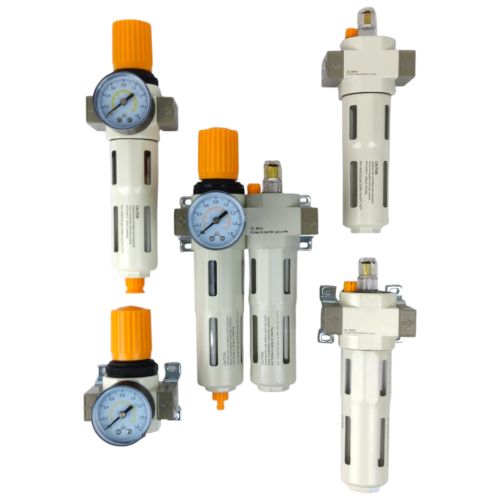
- Air regulators. Air regulators allow for precise pressure control in a pneumatic system. Thanks to them, you can ensure constant and safe pressure in devices, which translates into their optimal operation and minimization of the risk of damage. They are used in systems where pressure stability is crucial.
- Air filters. Air filters are used to clean compressed air of impurities, such as dust, oil particles, and moisture. They provide better air quality, which is especially important in precise applications, e.g., in the pharmaceutical industry or electronics.
- Air filter regulators. These devices combine the functions of a filter and a regulator in one compact solution. They are ideal in places where it is important both to maintain the appropriate pressure and to clean the air. They work well in industrial applications, saving space in the installation.
- Filter regulators with a lubricator. Filter regulators with a lubricator are advanced devices that, in addition to filtering and regulating pressure, also dose oil into the air. Air lubrication is essential in tools requiring lubrication, such as pneumatic wrenches or drills.
- Lubricators. Lubricators are devices used to add oil to compressed air, which ensures proper lubrication of moving parts in pneumatic tools. This reduces friction and wear of components, which extends their lifespan.
Pneumatic regulator
A pneumatic regulator is a device used in compressed air systems, whose task is to regulate and stabilize the air pressure supplied to the receivers. Its main function is to maintain a constant, optimal operating pressure, regardless of pressure fluctuations in the supply network. How does an air regulator work ? An air regulator works on the principle of a valve controlled by a spring or diaphragm mechanism. 1. Air inlet (high-pressure side) – supplies air with variable pressure from the pneumatic network. 2. Regulating element (spring or diaphragm) – controls the airflow and reduces its pressure to a set value. 3. Air outlet (low-pressure side) – supplies air with stabilized, set pressure to the end devices.
How does the air preparation process work ?
The air preparation process consists of several stages that ensure optimal quality and parameters for the entire pneumatic system: 1. Initial filtration. At the beginning, the air is cleaned of large solid particles and moisture using air filters. This eliminates impurities that could disrupt the operation of the devices. 2. Pressure regulation. Pressure regulators or filter regulators adjust the pressure to the requirements of pneumatic tools or machines. This ensures stable and safe operation of the system. 3. Lubrication In the case of devices requiring lubrication, lubricators introduce small amounts of oil into the air. This action protects moving parts and minimizes their wear. 4. Final control Thanks to the use of advanced air preparation blocks or filter regulators with a lubricator, the air is finally prepared, and all parameters are adjusted to the specific needs of the application.
What main devices does the compressed air generation system consist of?
The compressed air generation system includes several key devices: 1. Air compressor. This is the central element of the system that compresses the air and supplies it to the installation. It can be a piston, screw, or rotary vane compressor, depending on the requirements of the application. 2. Air dryers They remove moisture from the air, preventing problems related to condensation, which could damage tools or system components. 3. Compressed air tank. Stores compressed air, ensuring a stable supply and reducing the load on the compressor. 4. Filters and separators. They eliminate mechanical impurities and oil residues from the air, improving its quality. 5. Control valves. They allow for precise control of airflow and air pressure in the system.
Air preparation blocks
Air preparation blocks are modular devices that integrate all necessary functions in one compact module. They may include filters, pressure regulators, lubricators, and other elements, tailored to the requirements of a specific application. Such solutions are used in more advanced pneumatic systems, where both efficiency and space saving are important. The blocks allow for easy assembly, maintenance, and quick adjustment of the system parameters.
Help in choosing pneumatic devices
We invite you to contact our sales department, which will be happy to help you choose the optimal solution. In our offer, you will find all the elements necessary to build a complete compressed air installation : we offer pneumatic fittings, air hoses ( rubber hoses, polyurethane hoses, steel pipes ), pneumatic quick couplings, and distributors ( two-way, three-way, manifold blocks ) as well as all types of air preparation units, thanks to which you will create a safe and customized installation powered by compressed air. In our offer, you will find complete sets for compressed air preparation. We have all kinds of elements necessary for proper air preparation in a workshop, home, company, etc. In our offer, you will find : pneumatic regulators , air filter regulators, lubricators ( lubrication ), filter regulators with lubricators and others.
Compressed air preparation – what it is and why it matters
Compressed air preparation is the process of air treatment in pneumatic installations, which has a direct impact on the durability, reliability, and operating efficiency of the entire system. The air generated by the compressor contains moisture, solid particles, and oil residues, which without proper preparation can lead to failures of pneumatic components and a decrease in equipment performance.
How the compressed air preparation process works in a pneumatic installation
The compressed air preparation process is carried out using air preparation units, which most often consist of a filter, a pressure regulator, and a lubricator. The filter removes mechanical impurities and condensate, the regulator is responsible for stabilizing and regulating the operating pressure, while the lubricator ensures proper lubrication of working elements in the pneumatic system. Such a solution allows you to obtain air with parameters tailored to a specific application.
Application of compressed air preparation in practice
Compressed air preparation is used in workshops, industrial plants, assembly lines, and in systems powering pneumatic tools. Properly treated air reduces the wear of cylinders, valves, and hoses, improves the precision of tool operation, and reduces service costs. Stable air parameters are particularly important in installations operating in continuous mode.
Selecting a compressed air preparation unit
When choosing a compressed air preparation unit, one should take into account the airflow, the pressure regulation range, and the operating conditions of the installation. Hydron's offer includes air preparation units intended for various pneumatic applications, enabling effective treatment of compressed air and stable operation of the entire system. Check the available solutions and match them to your installation.
Air preparation block – what it is used for
An air preparation block is one of the most important elements of pneumatic installations, responsible for the proper preparation of compressed air before it is supplied to tools, machines, and pneumatic cylinders. Its main task is to clean the air of solid impurities and moisture, stabilize the operating pressure, and – if necessary – precisely lubricate actuators. By using an air preparation block, the pneumatic installation operates stably, safely, and maintains a long lifespan of connected devices. In practice, an air preparation block eliminates typical problems resulting from inadequate compressed air quality, such as corrosion of elements, valve jamming, performance drops, or accelerated wear of pneumatic tools. It is an essential solution both in simple workshop installations and in extensive industrial systems, where repeatability of operating parameters is required.
Air preparation assembly – elements and functions
The air preparation assembly consists of several components working together, each of which performs a strictly defined function in the process of conditioning compressed air. The basic element is the air filter, whose task is to remove solid particles, dust, rust, and condensed water resulting from air compression. Filtration is of key importance for protecting the entire pneumatic installation against damage and a decrease in efficiency. Another element of the air preparation assembly is the pressure regulator, responsible for lowering and stabilizing the operating pressure to the level required by a given device or pneumatic system. A constant and properly selected operating pressure translates into the precision of tool operation and the safety of the entire installation. In many applications, an important role is also played by the lubricator, whose task is to dose oil mist into the compressed air stream. Lubrication is especially important for pneumatic tools and moving parts that require protection against friction and excessive wear. Thanks to this, the air preparation assembly ensures optimal operating conditions even in intensively used installations.
Air preparation assembly – what it consists of
A standard air preparation assembly most often comes in a configuration defined by the abbreviation FRL, which means filter – regulator – lubricator. Depending on the needs of the pneumatic installation, individual elements can occur as separate modules or as a compact air preparation block, ready for quick assembly. Such a solution simplifies the installation, limits the number of connections, and minimizes the risk of leaks. In more advanced systems, the air preparation assembly can be expanded with pressure gauges for pressure control, shut-off valves, safety valves, or additional filtration stages. The choice of the appropriate configuration depends on the type of application, the required air purity, and the operating parameters of the pneumatic installation. A properly selected air preparation block allows not only to increase the reliability of the system, but also to reduce operating costs by limiting failures and downtime. On the Hydron website, various air preparation units are available, intended for workshop, industrial, and service applications. A wide selection of configurations allows for matching the air preparation assembly to a specific pneumatic installation, ensuring stable operating parameters, a long lifespan of components, and the safe use of the entire system0.
Air preparation station how does it work in practice?
An air preparation station is a basic element of any pneumatic installation, which is responsible for the quality of the compressed air supplied to the devices. In practice, this means cleaning the working medium, stabilizing the pressure, and – if necessary – lubricating it. Hydron's offer includes complete air preparation units, which ensure the reliable operation of pneumatic systems both in workshops and in industry. A standard air preparation station in hydraulics and pneumatics is based on the proven FRL (Filter – Regulator – Lubricator) system, which constitutes the foundation for the proper operation of the installation.
What does an air preparation station consist of?
Every air preparation station consists of three basic elements that cooperate with each other in a continuous and direct manner:
- The air filter is responsible for removing mechanical impurities, such as dust, rust or solid particles, as well as for the separation of water and condensate. In practice, it is the filter that acts as a separator, which is why separate cyclone separators are not used in standard sets. Thanks to this, the system is simple, compact, and effective.
- The pressure regulator (regulator) allows for precise setting and maintaining a constant operating pressure in the installation. This is extremely important for the proper operation of pneumatic tools, cylinders, and valves, because too high or unstable pressure can lead to their damage.
- Lubricator (lubricator) is responsible for supplying oil mist to the compressed air. This element is used in installations where additional lubrication of components is required, which significantly extends their lifespan and improves the smoothness of operation.
How does an air preparation station work?
The operating principle of an air preparation station is simple but extremely important for the entire pneumatic system. The compressed air first goes to the filter, where it is cleaned of impurities and moisture. Then it passes through the regulator, which stabilizes its pressure to a set value. In the last stage – if the installation requires it – the air is enriched with oil mist in the lubricator. Such a process ensures optimal operating conditions for the entire pneumatic installation and minimizes the risk of failure. Proper air preparation has a direct impact on the durability of elements such as pneumatic fittings, quick couplings or hoses.
Application of air preparation stations
Air preparation stations are used in many industries where compressed air is utilized. They are commonly used in car workshops, industrial plants, production lines, and power hydraulics services. They prove themselves wherever reliability, repeatability of work, and protection of installation components are required. In practice, the lack of a proper air preparation station leads to faster wear of system elements, a decrease in efficiency, and an increase in operating costs.
Gallery:
expand text What is an air preparation block ?
What is an air preparation block ?
An air preparation block, also known as FRL (Filter, Regulator, Lubricator), is an essential element of every pneumatic installation. Its main task is to ensure that the compressed air entering the devices is properly cleaned, has a stable pressure, and – if necessary – is additionally lubricated. Thanks to this, the pneumatic system works reliably, and individual components wear out much slower.
Construction and operation of an air preparation block
A typical air preparation block consists of three basic modules:
Filter – removes solid impurities (dust, filings, rust) and water condensate formed in the installation. This protects valves, cylinders, and pneumatic tools from failures.
Pressure regulator – stabilizes the pressure in the system. Compressed air from the compressor can have variable parameters, which is why the regulator ensures a constant and safe operating pressure tailored to the receivers.
Lubricator – introduces a small amount of oil into the air, which reduces friction and protects moving parts of machines and tools. It is not always required, but in many applications, it significantly extends the lifespan of the devices.
Application of air preparation blocks in practice
Air preparation blocks are used in almost every pneumatic installation, including:
– in car workshops – e.g., to power pneumatic wrenches, spray guns, or service tools,
– in industrial automation – where stable and clean air is crucial for the correct operation of cylinders and valves,
– in production and assembly lines – they ensure constant air parameters, which minimizes the risk of downtime,
– in compressed air installations in industrial plants – they guarantee the optimal operation of entire control systems.
Why is it worth using an air preparation block ?
The use of FRL blocks brings many benefits: it extends the lifespan of machines and tools, ensures stable operating conditions for the entire installation, protects the system from moisture and impurities, minimizes the risk of failures and costly repairs, and increases the efficiency of industrial processes.