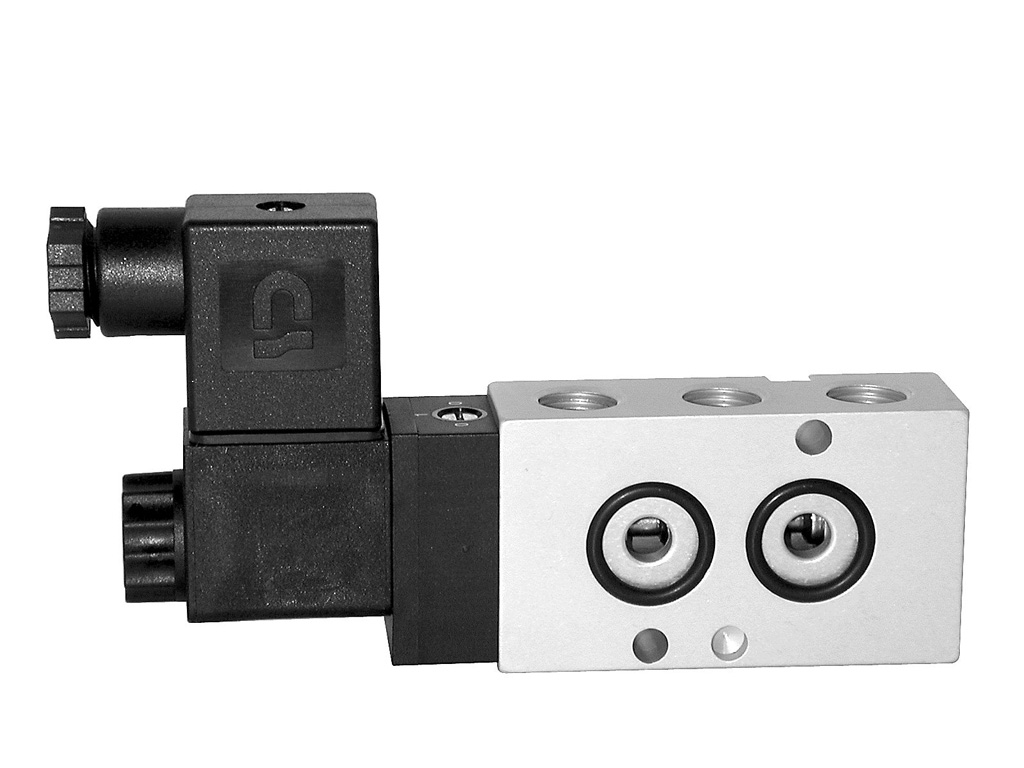
Pneumatic solenoid valves
In our offer, you will find pneumatic solenoid valves with various voltages: 12V, 24V, 220V. Air solenoid valves are electrically controlled. We also offer manually controlled air valves (manual valves). Example application of solenoid valves: used for controlling pneumatic cylinders, used in woodworking machines, industrial machines, and others. We can equip solenoid valves with fittings, silencers, and other accessories. In our offer, you will find fittings for solenoid valves (for pneumatic hoses 6, 8, 10, 12, 15 mm.)
Pneumatic solenoid valve
What are pneumatic solenoid valves? Pneumatic solenoid valves are devices that enable precise control of air flow in pneumatic systems. They work thanks to the use of an electromagnet (coil), which activates a mechanism that opens or closes the flow. Solenoid valves are a key element of industrial automation systems, allowing for fast and effective process management, increasing precision, and reducing operating costs.
Pneumatic solenoid valve – principle of operation
A pneumatic solenoid valve works on the principle of using an electromagnet (coil) to control air flow. After voltage is applied to the coil, a magnetic field is generated, which moves the valve core, opening or closing the flow in the system. When the voltage is disconnected, a spring returns the core to its starting position. Thanks to this design, solenoid valves provide fast, precise, and reliable air flow control in pneumatic systems.
Subcategories of pneumatic solenoid valves
3/2 solenoid valves.
3/2 solenoid valves are valves with three ports and two working positions. They are most often used in applications where it is necessary to switch between open and closed states. Their compact design and versatility make them ideal for controlling small pneumatic cylinders or closing air flow in simple control systems.
5/2 solenoid valves with one coil
5/2 solenoid valves with one coil are equipped with five ports and two working positions, but one electromagnetic coil is used for their operation. They are used in more advanced pneumatic systems where controlling the movement of cylinders in two directions is required, with an automatic return to the initial position after the coil is switched off.
5/2 solenoid valves with two coils
5/2 solenoid valves with two coils offer five ports and two working positions, but unlike the version with one coil, they have two controlling electromagnets. Thanks to this, they allow for more precise control of the cylinder position in both directions, independently of the return to the initial position. These types of valves are indispensable in applications that require greater control and flexibility.
Solenoid valve coil
What is a solenoid valve coil? Solenoid valve coil is a key element of the solenoid valve, responsible for generating the magnetic field that activates the mechanism opening or closing the flow. A coil is a wound wire conducting electric current, which after being energized produces an electromagnetic field. In pneumatic systems, coils with various parameters are used, such as supply voltage (e.g., 12V, 24V, 230V) or mounting method. Thanks to the easy replacement of coils, solenoid valves are durable and economical to operate.
Solenoid valve plug
What is a solenoid valve plug? Solenoid valve plug is the element responsible for connecting the solenoid valve coil to the electrical installation. It enables safe and stable current transmission, ensuring the correct operation of the entire system. Plugs available in the Hydron offer are characterized by high quality of workmanship, which guarantees their durability and resistance to external factors such as moisture or vibrations.
Power supply for pneumatic solenoid valves
Pneumatic solenoid valves require electrical power to activate the electromagnetic coil that controls air flow. The power supply can come in various voltage values, such as 24V, 12V, or 230V. Each type of power supply has its specific applications and advantages.
Popular types of power supply for solenoid valves
24V (DC) solenoid valve
A 24V DC (direct current) power supply is one of the most commonly used in pneumatic solenoid valves. It is characterized by a high level of safety and operational stability, making it an ideal choice for industrial applications and automation systems. Low voltage reduces the risk of electric shock, which makes 24V DC a popular solution in systems where safety is a priority.
Solenoid valve 12V (DC)
12V DC power supply is mainly used in mobile devices or in places where the power source is a battery (e.g., in vehicles, agricultural machinery). Thanks to the low voltage, it is just as safe as 24V, but due to the lower power, it is less frequently used in large industrial installations.
Solenoid valve 230V (AC)
230V AC (alternating current) power supply is often used in stationary installations where access to a standard power grid is easily available. Solenoid valves with such voltage eliminate the need for additional transformers or power supplies, which can be convenient in simpler applications. However, higher voltage requires greater caution during installation and maintenance to ensure user safety.
Which power supply is the most popular?
The most commonly used voltage in pneumatic systems is 24V DC, because it combines safety, versatility, and ease of integration with modern automation systems. 12V DC voltage is used in more specific mobile applications, while 230V AC works well in simple stationary installations where low-voltage separation is not required. How to choose the right power supply? The selection of the appropriate power supply depends on the specifics of the installation, the availability of a power source, and safety requirements. When choosing, it is worth considering aspects such as the type of device, work environment, and compatibility with existing systems. At the Hydron store, our specialists are ready to help you choose the right solenoid valves and their power supply.
Air solenoid valve
An air solenoid valve, also called a pneumatic solenoid valve, is an electromechanical valve that opens or closes the air flow path under the influence of an electrical signal. This allows for precise directing of air in pneumatic systems, which translates into smooth and efficient operation of the entire installation. Depending on the application, solenoid valves can have different designs and numbers of ways: 2/2-way – perform simple opening and closing of air flow. 3/2, 5/2, 5/3 – more advanced designs that allow for controlling single-acting or double-acting cylinders, as well as positioning elements in the system.
Modern solutions in pneumatic automation
Pneumatic solenoid valves available in the Hydron offer are professional fitting elements responsible for automatic control of compressed air flow in pneumatic systems. They enable precise directing of the working medium to the appropriate places in the installation, which is crucial for the efficient operation of cylinders, control valves, and other system components.
How do pneumatic electromagnetic valves work?
The principle of operation of solenoid valves is based on the use of an electromagnetic coil which – after an electrical signal is given – changes the position of the piston or spool inside the valve. As a result, air is directed to the appropriate channel or is cut off. Such a solution allows for a simple way to control the movement of executive elements without the need for manual operation of the system.
Types and construction of solenoid valves
The Hydron offer includes various types of valves – from compact 2/2-way versions, through 3/2-way used to control single-acting cylinders, to 5/2 and 5/3-way used in systems with double-acting cylinders. The valve body is made of aluminum or brass, which guarantees corrosion resistance, and high-class seals ensure tightness even with large fluctuations in pressure and temperature.
Where are pneumatic solenoid valves used?
Electromagnetic valves find application in many fields of technology and industry. They are used, among others, in: industrial automation, where they control the movement of cylinders and feeding systems, pneumatic transport systems, workshop and assembly installations, control systems for production, packaging, and sorting machines, pressure maintenance systems, and compressed air distribution. Thanks to their reliability and speed of operation, Hydron solenoid valves are perfect for both simple control systems and complex automation systems. Solenoid valves from the offer stand out not only for their durability, but also for their high work culture and accuracy of operation. Their main advantages are: fast electromagnet response, enabling dynamic switching, compact design adapted for installation in various positions, resistance to external factors and vibrations, low electricity consumption, compliance with industrial requirements and safety standards.
Pneumatic directional control valve
A pneumatic directional control valve is one of the basic elements used in compressed air installations and industrial automation systems. Its task is to control the direction of air flow in the pneumatic system, thanks to which it is possible to control the operation of pneumatic cylinders, drives, and other executive elements. In practice, a pneumatic directional control valve is responsible for switching air flow channels and directing the working medium to the appropriate parts of the installation.
Elements of this type are used in many industrial applications where fast and precise motion control is required. Pneumatic directional control valves can be controlled manually, mechanically, or electrically, and in the case of industrial automation, pneumatic solenoid valves enabling remote control of the installation's operation are very often used. Such a solution allows for the integration of pneumatic systems with production lines, automation systems, and PLC controllers.
In pneumatic installations, directional control valves most often cooperate with elements such as pneumatic cylinders, pneumatic hoses and pneumatic fittings. Proper selection of the valve is of great importance for the efficiency of the entire system, as it affects the response speed of cylinders, the stability of the installation, and safety of use. Parameters such as the number of valve ways and positions, the diameter of connections, or working pressure should always be matched to the requirements of a specific application.
The Hydron offer includes various types of valves used in compressed air installations, including modern pneumatic solenoid valves used in industrial automation, workshops, and technological lines. Thanks to a wide range of pneumatic fittings, it is possible to complete entire compressed air installations – from control valves, through hoses and fittings, to air preparation elements. When choosing the right solution for a specific installation, the Hydron team helps to select the right components that will ensure reliable and stable operation of the pneumatic system.
Pneumatic solenoid valve – principle of operation
A pneumatic solenoid valve is an element controlling the flow of compressed air in pneumatic installations. Its operation consists of automatically switching air flow channels in response to an electrical signal. Thanks to this, it is possible to control the operation of devices such as pneumatic cylinders, drives, or industrial automation elements. The basis of the solenoid valve's operation is an electromagnet, i.e., an electrical coil producing a magnetic field after voltage is applied. When the coil is energized, the magnetic field attracts a movable core or valve spool, which changes the position of the air flow channels. As a result, compressed air is directed to the appropriate port of the pneumatic installation, which triggers the cylinder or changes its movement direction. After disconnecting the voltage, the core returns to its starting position thanks to a return spring, restoring the original flow arrangement.
In pneumatic installations, solenoid valves act as directional control valves that control the direction of air flow in the system. Depending on the design, they can have a different number of ways and positions, e.g., 3/2 valves used with single-acting cylinders or 5/2 valves used in systems with double-acting cylinders. Proper valve selection affects the response speed of the system, the stability of the installation, and the efficiency of controlling the entire pneumatic system.
Pneumatic solenoid valves are commonly used in industrial automation, production lines, packaging machines, transport devices, and workshops using compressed air installations. In combination with elements such as pneumatic hoses, pneumatic fittings, and pneumatic cylinders, they enable the creation of fully automated motion control systems in many branches of industry.
Gallery: