










DKJ90 UNF (C92) fittings
Produkty z kategorii
DKJ 90° elbow fittings (C92)
90° elbow fittings for hoses with UNF female thread
90° degree JIC (UNF) elbow fitting with a 74° seat and internal thread (IT). DKJ 90° is an elbow fitting with an inch internal thread nut and a 74° concave cone. These fittings are commonly known as "American" fittings and are primarily found in construction machinery, forestry machinery, and modern agricultural equipment (e.g., John Deere). This type of fitting is designated in Poland as a C92 (DKJ90) fitting. Elbow fittings can be replaced by AB UNH elbows (elbow connectors with a nut). Construction: zinc-plated free-cutting steel. Our offer includes 45-degree versions and straight fittings. The fittings are compatible with AGJ fittings (external thread). Our offer also includes elbow fittings designed for air conditioning
DKJ 90° elbows
DKJ90 UNF fittings are hydraulic crimp fittings with a 90° bend angle, which are indispensable in high-pressure systems. Used in applications requiring a durable and tight connection, they offer excellent performance even in the most demanding conditions. Construction and specification: Construction: DKJ90 UNF fittings are characterized by a 90° bend angle and a precise UNF thread. Material: Made of high-quality carbon steel or stainless steel, ensuring durability and corrosion resistance. Available variants: A wide selection of sizes and diameters allows for matching to various types of hydraulic hoses.
Application of UNF elbow fittings
Fittings of this type facilitate connections in hard-to-reach places, thanks to the 90° bend. Ideal for installation in hydraulic systems in the construction, agricultural, and automotive industries. Suitable for systems requiring resistance to high pressures and temperatures. Alternative product versions: Our offer also includes other types of DKJ UNF fittings: DKJ45 UNF (45°) fittings – dedicated to installations requiring connections at a 45° angle: DKJ45 UNF fittings. Straight DKJ UNF fittings – universal, ideal for straight connections in hydraulic systems: Straight DKJ UNF fittings. Hydraulic connectors with UNF / JIC threads: To provide comprehensive solutions, we also offer a full range of hydraulic connectors with UNF threads, compatible with DKJ fittings: JIC hydraulic connectors (UNF threads). Industries where these types of fittings are used: Power hydraulics: high-pressure systems. Automotive: power steering systems. Heavy industry: machinery and equipment construction.
Technical parameters:
- Material: carbon steel, stainless steel.
- Thread type: UNF (Unified National Fine).
- Fitting version: 90°
- Working pressure: up to 420 bar.
- Matching fitting: AGJ C81 external
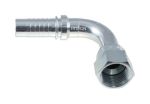
DKJ 90° UNF (C92) elbow JIC fittings for hydraulic hoses
DKJ 90° UNF fittings from the C92 group are elbow fittings for hydraulic hoses, used wherever the hose must be routed at a right angle to the connection point. The 90° elbow design facilitates installation at manifolds, actuators, pumps, and other hydraulic components, especially in areas with limited space.
C92 fittings utilize a JIC type connection with a UNF or UN internal thread and a 74° conical sealing surface. The swivel nut allows for convenient connection of the hose to the appropriate nipple without the need to rotate the entire hose.
DKJ 90° C92 fittings-key features
- fitting version: 90° elbow,
- group designation: C92 / DKJ90,
- connection type: JIC,
- thread: internal UNF or UN, depending on the size,
- sealing: on a 74° cone,
- range of hose diameters includes many popular hydraulic sizes,
- construction is selected depending on the specific fitting variant,
- purpose: manufacturing of crimped hydraulic hoses.
Where are DKJ 90° hydraulic fittings used?
The 90° elbow fitting allows the hose to be directed parallel to the surface of the device or machine structure. It is particularly useful where using a straight fitting would require a tight bend on the hose itself.
Such solutions are found, among others, in the hydraulic installations of agricultural, construction, municipal, and transport machinery, as well as industrial equipment. DKJ fittings are also used during the manufacture of hoses for systems where the American JIC connection standard is applied.
- hydraulic cylinder connections,
- hydraulic manifolds and blocks,
- hydraulic pumps and motors,
- installations routed in limited space,
- hoses requiring a change of direction directly at the connection.
JIC 37° and 74° cone-what do these values mean?
In JIC connection designations, you can find both the 37° and 74° terms. These are not two different standards. The sealing surface is inclined at a 37° angle relative to the axis of the connector, while the full angle formed by the cone is 74°.
Sealing occurs by pressing the mating metal conical surfaces together. Therefore, when selecting a fitting, it is not enough to check only the thread diameter. You must also ensure that the mating connection has the correct JIC sealing standard.
UNF and UN threads in C92 fittings
In the DKJ 90° group, there are various sizes of inch threads. In smaller connections, primarily UNF threads with a fine pitch are used, while for larger diameters, threads from the UN family can also be found.
Example sizes found in this group include:
- 7/16" UNF,
- 1/2" UNF,
- 9/16" UNF,
- 3/4" UNF,
- 7/8" UNF,
- 1.1/16" UN,
- 1.3/16" UN,
- 1.5/16" UN,
- 1.5/8" UN.
Before ordering, it is worth comparing the nominal thread diameter, its pitch, and the hose diameter. Visually similar fittings may have different connection parameters.
How to choose a DKJ 90° fitting for a hydraulic hose?
The basis for correct selection is the internal diameter of the hose and its construction. The fitting and the crimp ferrule must be compatible with the specific type of hose and the crimping technology.
When choosing, you should check:
- nominal hose diameter DN,
- type and construction of the hydraulic hose,
- diameter and pitch of the UNF or UN thread,
- JIC sealing surface standard,
- required 90° fitting orientation,
- permissible operating parameters of the specific variant.
If the installation does not require a direction change of a full 90°, it is also worth checking DKJ 45° UNF C95 fittings. They allow the hose to be routed at a gentler angle.
Hose DN versus fitting size
In the C92 category, variants are available for many typical hydraulic hose diameters, including:
- DN06 – approx. 1/4",
- DN08 – approx. 5/16",
- DN10 – approx. 3/8",
- DN12/DN13 – approx. 1/2",
- DN16 – approx. 5/8",
- DN19/DN20 – approx. 3/4",
- DN25 – approx. 1",
- DN32 – approx. 1.1/4",
- DN38/DN40 – approx. 1.1/2".
Selection should always be based on the data of the specific hose and fitting, as the DN value alone does not determine the complete compatibility of the set.
Crimping hydraulic hoses with C92 fittings
A correctly made hydraulic hose requires selecting a compatible hose, fitting, and ferrule, and applying the correct crimping diameter. Over-tightening or under-tightening can affect the durability and tightness of the hose.
If you need a ready-made hose, you can use the offer of HYDRON crimped hydraulic hoses and select the appropriate ends for a specific application.
Frequently Asked Questions (FAQ)
How does the DKJ 90° C92 fitting differ from the DKJ 45° C95?
The primary difference is the geometry of the fitting. The C92 changes the routing direction of the hose by 90°, while the C95 uses a 45° bend. Selection depends on the arrangement of connections and the available space.
Does DKJ mean a JIC connection?
Yes. In this group, the fitting has a swivel nut with an internal thread and a sealing surface characteristic of the JIC standard.
Do JIC 37° and 74° cone mean the same connection?
Yes. 37° refers to the angle of the sealing surface relative to the connector axis, while 74° is the full angle of the cone.
How to check the UNF thread size?
You must determine the outer diameter of the mating thread and its number of threads per inch. Measuring the diameter alone is not always sufficient to uniquely determine the size.
Can a DKJ 90° fitting be selected based solely on the hose DN?
No. In addition to the DN diameter, the hose construction, required thread, sealing standard, and compatibility of the fitting and ferrule with the given hose type must be considered.