










DKOL90, DKOS90 O-ring fittings (P52)
Produkty z kategorii
Angular fittings with o-ring DKOL90 (P52) and DKOS90 (P52S) IT- internal thread
Metric angular fittings with o-ring and 24° degree cone.
What are DKOL90° DKOS90° fittings?
DKOL-90 and DKOS-90 fittings are hydraulic elements dedicated to hydraulic hose connections at a 90° angle. They are characterized by a metric internal thread and an O-Ring type seal. Designed according to the DIN 2353 standard, they guarantee leak-tight and durable connections in hydraulic installations operating at high pressure. Metric elbow fittings, bent at a 90-degree angle (right angle). Metric elbow fittings are divided into two types: light version DKOL90 and heavy version DKOS90. These fittings differ depending on the cone size (heavy version has smaller cones) Click to learn more about differences between DKOL and DKOS. 90-degree metric elbow fittings are designated in Poland as P52 fittings.
What does a hose fitting consist of?
A complete fitting consists of an elbow body, a slip-on or crimped nut, and a Teflon ring ( which prevents the nut from falling off ) On one side, the fitting ends with a so-called "hose tail" (Christmas tree) which goes inside the hose, on the other side with a nut that we screw onto an external thread, e.g. a straight metric connector
Where is this type of fitting used?
DKOL-90 and DKOS-90 fittings are used in a wide range of hydraulic systems: Maszyny budowlane i rolnicze: In hydraulic control system connections. Heavy industry: In power hydraulic installations requiring a change in the direction of the medium flow. Why choose DKOL-90 and DKOS-90 fittings? They guarantee durability and tightness in demanding operating conditions. High resistance to variable temperatures and pressure. Availability in various variants and sizes allows matching to most hydraulic installations.
Other versions of DKOL DKOS metric fittings
- DKOL45 and DKOS45 fittings: 45° angle version.
- DKOL and DKOS straight fittings: Straight version of the fitting
- Inter-Lock fittings: reinforced for high-pressure installations (e.g., R15, 6SH).
Technical parameters of the fittings
- Thread type: Metric internal.
- Cone : 24 degrees
- o-ring on cone : yes
- Hose diameters: DN 6–DN 38.
- Standards: Compliance with DIN 2353.
- Working pressure: Up to 630 bar (heavy series).
- Purpose : fittings intended for crimping on hydraulic hoses
- Available threads : M10, M12, M14, M16, M18, M20, M24, M26, M30, M36, M40, M42, M52
- Material: Carbon steel or stainless steel
- Matching fittings : with CEL external thread and CES
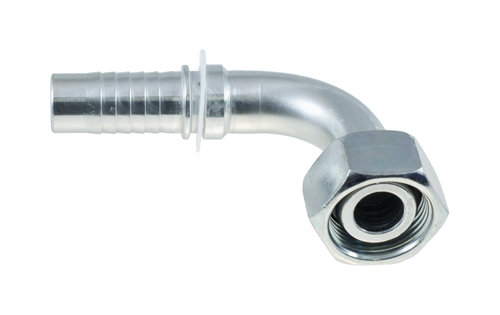
DKOL 90° DKOS 90° P52 fittings with O-ring
DKOL 90° and DKOS 90° P52 fittings with O-ring are angular fittings for hydraulic hoses with a metric internal thread and a seal on a 24° cone. The 90° design allows for convenient hose routing in limited installation space. DKOL versions are intended for light series L connections, while DKOS work with heavy series S connections. The O-ring placed in the sealing part improves the tightness of the connection and allows for a secure connection of the hose with a properly selected stub or connector.
Key parameters of DKOL 90° and DKOS 90° fittings
- type: angular hydraulic fitting,
- angle: 90°,
- thread type: metric, internal,
- sealing system: 24° cone with O-ring,
- DKOL: light series L,
- DKOS: heavy series S,
- catalog family designation: P52 / P52S,
- purpose: crimped hydraulic hoses,
- selection: according to hose DN, thread, and connection type L or S.
What are DKOL 90° and DKOS 90° fittings?
DKOL and DKOS are designations used for hydraulic hose fittings working with metric pipe connections using a 24° cone. The fitting has a movable nut with an internal thread, so the hose can be connected to the appropriate external thread without rotating the entire hose.
The 90° angular version is particularly useful when a straight hose would require too large a bending radius or would interfere with the machine's construction.
DKOL vs DKOS - what is the difference?
The most important difference is the pipe connection series. DKOL and DKOS designations should not be treated as two names for the same product.
- DKOL - fitting intended for the light series L,
- DKOS - fitting intended for the heavy series S.
The series affects the geometry of the cooperating connection, the assignment of the thread to the pipe diameter, and the selection of other installation components. Therefore, when replacing a fitting, it is necessary to determine not only the thread diameter but also whether the installation is made in the L or S series.
Why is the metric thread alone not enough for selection?
One of the most common mistakes is selecting a fitting based solely on thread measurement. In metric systems, the same thread can occur with different pipe diameters and in different series.
For example:
- M14x1.5 can occur as 8L or 6S,
- M16x1.5 can correspond to the 10L or 8S configuration,
- M18x1.5 can occur as 12L or 10S,
- M22x1.5 can correspond to the 15L or 14S configuration,
- M30x2 can occur as 22L or 20S.
Therefore, correct selection should include the thread, L or S series, the diameter of the cooperating pipe, and the nominal diameter of the hydraulic hose.
How does the 24° cone seal with O-ring work?
In DKOL and DKOS fittings, connection tightness is not achieved by the thread alone. The thread is primarily responsible for pressing the cooperating elements together.
The 24° cone geometry and the O-ring are responsible for the proper seal. After tightening the nut, the cooperating surfaces are properly pressed, and the elastomeric sealing ring limits the possibility of the medium escaping from the connection.
For this reason, this type of fitting should not be treated like a classic pipe thread sealed with PTFE tape.
O-ring in a hydraulic fitting - why is it used?
The O-ring is an additional element sealing the connection and works together with the appropriately shaped conical surface. Its correct condition has a direct impact on the tightness of the connection.
During assembly, it is worth checking if the O-ring:
- is not cut,
- has not been flattened,
- has no cracks,
- is not twisted in the groove,
- is appropriate for the given fitting type.
Damage to the O-ring can cause a leak even if the nut has been properly tightened.
Why might a 90° fitting be better than a straight one?
DKOL 90° and DKOS 90° fittings are used primarily where the hose must change direction directly at the connection point.
Using an angular fitting can:
- limit the need for severe hose bending,
- facilitate assembly in tight spaces,
- reduce stresses acting on the hose,
- improve the installation routing,
- limit the risk of the hose rubbing against the machine structure.
Hose bending radius matters
A flexible hydraulic hose should not be sharply bent directly behind the crimp sleeve. Too small a bending radius causes additional stresses on the hose and can accelerate its wear.
If the connection point is close to a wall, machine frame, or other structural element, using a 90° fitting often allows the hose to be routed in a more favorable direction starting from the connection itself.
How to select a DKOL 90° or DKOS 90° fitting for a hose?
Selection should begin by determining the hose parameters and the connection point. The information "metric thread" alone is insufficient.
Before purchasing, check:
- the nominal DN diameter of the hydraulic hose,
- the metric thread size,
- the thread pitch,
- whether the DKOL or DKOS system is required,
- the L or S connection series,
- the fitting angle 90°,
- the type of cooperating cone,
- compatibility of the fitting and sleeve with the construction of the hose used.
The fitting and sleeve must form the correct crimping system
The P52 fitting is only one of the elements of a complete hydraulic hose. To perform correct crimping, a properly selected crimp sleeve is also needed.
The sleeve is selected according to the type and diameter of the hose and the design of the fitting. You should not use a random combination of elements just because they can be mechanically connected.
An incorrect combination of fitting, sleeve, and hose can result in:
- improper crimp diameter,
- shifting of the fitting in the hose,
- damage to hose layers,
- oil leakage,
- the fitting being pulled out during operation.
Most common mistake: DKOL instead of DKOS
Light and heavy series fittings can look very similar at first glance. It is especially easy to make a mistake when the user is guided solely by the thread diameter.
Installing a DKOL fitting for a connection requiring DKOS or vice versa can cause improper seating of the sealing elements. This can result in connection leaks, problems with proper tightening, or damage to the cooperating surfaces.
How to recognize which fitting you need?
If you are replacing an existing hose, it is worth checking several elements before its disassembly:
- read the hydraulic hose marking,
- measure or determine its DN diameter,
- check the thread diameter with a caliper,
- determine the thread pitch,
- check the L or S series of the cooperating connector,
- compare the cone shape and the sealing method,
- check the elbow orientation relative to the second fitting of the hose.
Setting two angular fittings on one hose
If the hose has angular fittings on both sides, their mutual angular orientation is important. After crimping, the fittings cannot be freely rotated relative to the hose.
When making a new hose, it is therefore worth providing not only its length but also the position of both fittings. This is of particular importance in tight machine layouts, where even a slight angular shift can make assembly difficult.
Where are DKOL 90° and DKOS 90° fittings used?
Angular metric fittings are widely used in mobile and industrial hydraulics. They can be found in, among others:
- agricultural machinery,
- tractors and loaders,
- construction machinery,
- forestry machinery,
- hydraulic power units,
- presses and industrial equipment,
- hydraulic control systems,
- hoses connecting manifolds, valves, and actuators.
Practical example - hose at a hydraulic manifold
If the manifold stub is close to the machine wall, using a straight fitting may require a sharp bend of the hose immediately after the sleeve.
A DKOL 90° or DKOS 90° fitting allows the hose to be directed downward or sideways directly at the connection. Thanks to this, the hose can work with a larger, safer bending radius and does not rest unnecessarily against the machine structure.
When not to choose a 90° fitting?
An elbow is not always the best solution. If the hose has enough space and can be routed straight without excessive bending, a simpler fitting may provide an easier installation.
In high-flow installations, it is also worth avoiding unnecessarily increasing the number of flow direction changes. Every elbow introduces an additional local pressure loss, so the hose route should be as straight as possible and adapted to the actual machine conditions.
Complete hydraulic hose - what else do you need?
To make a hose, not only the correct fitting is needed. The entire set must be selected as one system.
Depending on the application, the following will be needed:
- the correct type and DN of hydraulic hose,
- DKOL 90° or DKOS 90° fitting,
- the correct crimp sleeve,
- the fitting on the other side of the hose,
- a hose guard, if required by the workspace,
- a properly performed crimp.
If you do not want to complete all the elements yourself, you can order ready-made crimped hydraulic hoses tailored to the specific application.
Configure a hydraulic hose at HYDRON
When making a new hose, you need to select the length, hose diameter, and appropriate terminations on both sides. In the case of angular fittings, their orientation relative to each other is also important.
Use the HYDRON hydraulic hose configurator, to select the hose and appropriate terminations for your system.
Fittings and connectors for power hydraulics
The hose fitting must cooperate with the appropriate element on the machine side. When modernizing an installation, it is therefore worth verifying the entire connection point, and not just the hose itself.
In the HYDRON hydraulic connectors category, you will find elements for the construction and modernization of pipe and hose installations, including metric connectors used in 24° cone systems.
Most common mistakes in DKOL and DKOS selection
- selecting the fitting based solely on the thread,
- confusing the light L series with the heavy S series,
- not considering the hose DN diameter,
- selecting an incorrect crimp sleeve,
- confusing the 24° cone with another sealing system,
- not considering the 90° fitting orientation,
- using an elbow despite no need to change the hose direction,
- reusing a damaged O-ring.
FAQ - DKOL 90° and DKOS 90° P52 fittings
What is the difference between DKOL and DKOS?
DKOL is intended for light series L connections, while DKOS is for heavy series S. When selecting, you must check not only the thread but also the series and diameter of the cooperating pipe.
How is a DKOL 90° or DKOS 90° fitting sealed?
The connection uses a 24° cone and an O-ring. The thread is used primarily to obtain the correct pressure of the cooperating elements.
Can a fitting be selected by thread diameter alone?
No. The same metric thread can occur in different L and S series configurations. You must additionally confirm the series, connection size, and hydraulic hose DN.
When is it worth using a 90° fitting?
A 90° fitting is particularly useful in places with limited space, where using a straight fitting would require too sharp a bend in the hose directly at the crimp.
Do you need to select a suitable sleeve for the P52 fitting?
Yes. The fitting, crimp sleeve, and hydraulic hose must be selected as a compatible system. An incorrect sleeve can result in an improper crimp and loss of hose tightness.