










Complete hose fittings
Produkty z kategorii
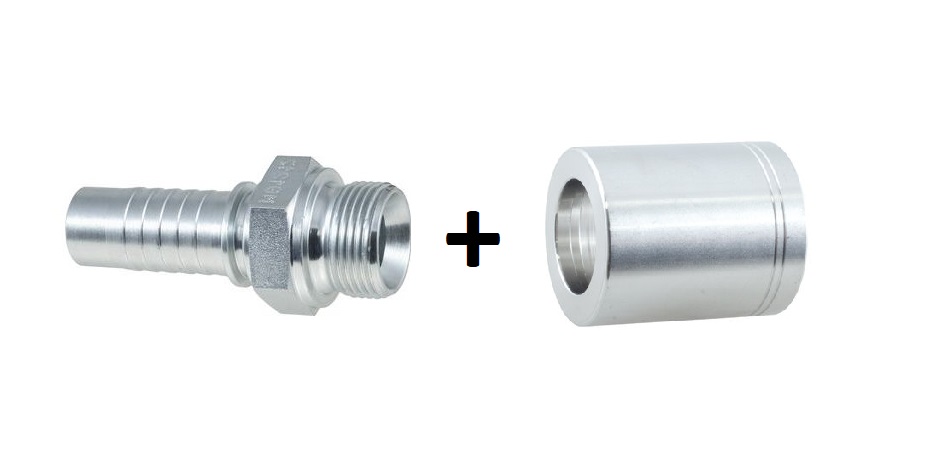
Complete hose fittings ( end + ferrule )
Accessories for hydraulic hose crimping
The term hydraulic hose crimping accessories covers a full group of components intended for the durable and safe production of hydraulic hoses. They include ends for hydraulic hose crimping, clamping ferrules, straight and elbow fittings, as well as solutions tailored to various hose types, diameters, and thread standards. These are components that, using a hose crimper allow for the production of a hose resistant to high pressure, vibration, and intensive operation in power hydraulic systems. These accessories form the basis of professional hose crimping, both in service workshops and in the production of hydraulic hoses for industrial, agricultural, and construction machinery.
Types of hydraulic fittings
A hydraulic fitting is a connecting element used in power hydraulic lines, whose task is the durable and tight connection of a hydraulic hose with an installation or device. Each complete hydraulic fitting consists of two basic parts: a crimping end and a crimping ferrule. The end is responsible for the threaded or special connection with another system element, while the ferrule is a clamping element that permanently connects the end to the hydraulic hose during the crimping process. Crimping involves mechanically clamping the ferrule onto the hose and the end's stem using a hose crimper. A correctly made fitting ensures tightness, high pressure resistance, and the operational safety of the entire hydraulic system.
What a hydraulic fitting consists of
A crimping end is a metal element, most often made of carbon or stainless steel, which has a stem inserted into the hose and a connection part in the form of a thread or another connection standard. The crimping ferrule, also called a sleeve, is slipped onto the outer layer of the hose and undergoes permanent deformation during crimping. It is the ferrule that is responsible for mechanically immobilizing the hose and transferring forces resulting from the working pressure. Selecting the appropriate ferrule must be consistent with the type of hose, its diameter, and construction, e.g., the number of steel braids. Improper combination of the end and ferrule can lead to leaks or damage to the hose.
Classification of hydraulic fittings by thread type
The most commonly used criterion for classifying hydraulic fittings is the thread type, which determines compatibility with other installation components.
Hose fittings with metric threads
Metric fittings are commonly used in the power hydraulics of European machinery. The most common versions feature a cone seal or a sealing ring. This group includes, among others, DKOL and DKOS ends, which differ in cone angle and sealing method. Metric fittings are available in both straight and elbow versions, facilitating hose routing in confined spaces.
Hydraulic fittings with BSP and BSPT inch threads
Fittings with BSP inch threads are very popular in industrial hydraulics and in machinery of British and Asian origin. The BSP thread can be cylindrical or conical, and sealing is achieved via a cone, gasket, or ring. BSPT threads are conical versions where tightness is achieved directly on the thread. This type of fitting is often found in older installations and in some industrial systems.
JIC type hose fittings
JIC fittings are based on an inch thread and a 37-degree sealing angle. They are widely used in power hydraulics, especially in machinery imported from the American market. Sealing is metal-to-metal, which ensures high pressure resistance and the possibility of multiple assembly and disassembly without loss of tightness.
ORFS fittings
ORFS fittings are a solution designed for the most demanding hydraulic applications. Sealing is achieved using an O-ring placed on a flat face. This type of fitting minimizes the risk of leaks even at very high pressure and vibrations, which is why it is often used in modern construction and industrial machinery.
NPT fittings and other special standards
Fittings with NPT threads have a conical inch thread where tightness is achieved on the thread. They are used mainly in American installations and in some industrial systems. In addition to these, special fittings are also encountered, such as flange ends, fittings for air conditioning systems, or fittings dedicated to industrial and fuel hoses.
Classification of fittings by shape
Hydraulic fittings are available in straight, 45-degree, and 90-degree elbow versions, as well as special versions. Choosing the correct fitting shape allows for proper hose routing, reduction of stress, and increased durability of the entire installation.
Importance of proper hydraulic fitting selection
The correct selection of a hydraulic fitting has a direct impact on the safety, durability, and tightness of the power hydraulic system. One should always consider the hose type, working pressure, type of medium, and the thread standard used in the installation. Professionally selected crimping ends and ferrules ensure a long hose service life and trouble-free machine operation. Hydraulic fittings available in the Hydron offer include a wide selection of ends and ferrules tailored to various hose types and thread standards, enabling the production of hydraulic hoses suited for specific industrial, agricultural, and mobile applications.