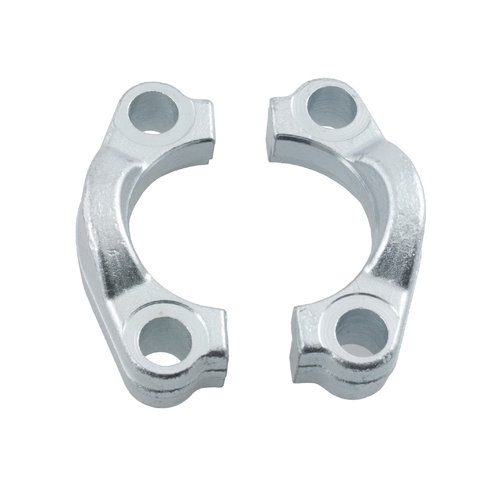
Split flanges for SAE 3000 and SAE 6000 flanges
What are split flanges for flanges ? Split flanges for flanges are precision assembly components used in power hydraulics that allow for a permanent and leak-tight connection of a hydraulic hose flange end with a device, pump, or manifold. They are installed by clamping two halves of the split flange onto the flange end and then bolting them to the flange surface using bolts. This type of connection provides exceptional resistance to pressure, vibrations, and dynamic loads, which is why it is widely used in industrial and mobile hydraulic systems.
Standards and pressure classes of SAE split flanges
All split flanges available in the offer meet the requirements of SAE J518 C and ISO 6162 standards, which define dimensions, strength, and installation methods. They come in two primary pressure classes: SAE 3000 psi – corresponds to the light class (Light Duty), with a working pressure of approximately 207 bar, used in most standard hydraulic systems. SAE 6000 psi – corresponds to the heavy class (Heavy Duty), with a working pressure of approximately 414 bar, intended for high-pressure systems and extreme operating conditions. Thanks to this classification, the user can select a split flange perfectly matched to the nature of their hydraulic installation – from light control systems to powerful industrial systems.
Construction and materials of Hydron split flanges
Hydron split flanges are made of high-grade free-cutting steel (St. 52.2), covered with a protective layer of galvanic zinc, which ensures their durability and resistance to corrosion. For environments with increased requirements (e.g., operation in humidity, contact with oils, chemicals), versions made of stainless steel 1.4571 are also available, which guarantee reliability in the most demanding conditions. Each split flange is manufactured with high precision, ensuring a perfect fit to the flange, full tightness, and resistance to working pressure in accordance with the SAE standard.
Differences between SAE 3000 psi and SAE 6000 psi split flanges
Differences between the two classes mainly consist of: material thickness – SAE 6000 split flanges are more massive and have stronger walls, bolt hole diameters – adapted to higher loads, application – 3000 psi for standard systems, 6000 psi for high-pressure systems, working pressure – 3000 psi ≈ 207 bar, 6000 psi ≈ 414 bar. The choice of the appropriate type depends on the operating parameters of the entire system – our technical advisors at Hydron help choose the best solution for a specific application.
Application of split flanges for flanges in power hydraulics
Split flanges for flanges are widely used in power hydraulic systems where durable and tight connections are required. They are used, among others, in: construction machinery – excavators, loaders, cranes, agricultural machinery – presses, sprayers, spreaders, industrial systems – production lines, hydraulic presses, mobile systems – special and heavy-duty vehicles. Thanks to their high resistance to pressure and vibration, SAE split flanges are indispensable in installations exposed to intensive use.
How to choose the right split flange for a flange?
When choosing a split flange, it is worth paying attention to:
-
Flange size – nominal diameter must correspond to the hose diameter.
-
Pressure class (SAE 3000 or 6000) – consistent with the parameters of the hydraulic system.
-
Type of material – galvanized carbon steel or stainless steel.
-
Number and spacing of mounting holes – matched to the flange and pump.
-
Type of working medium – hydraulic oil, fuel, technical fluid.