










Railway hoses
Produkty z kategorii
Railway hoses compliant with EN 45545-2
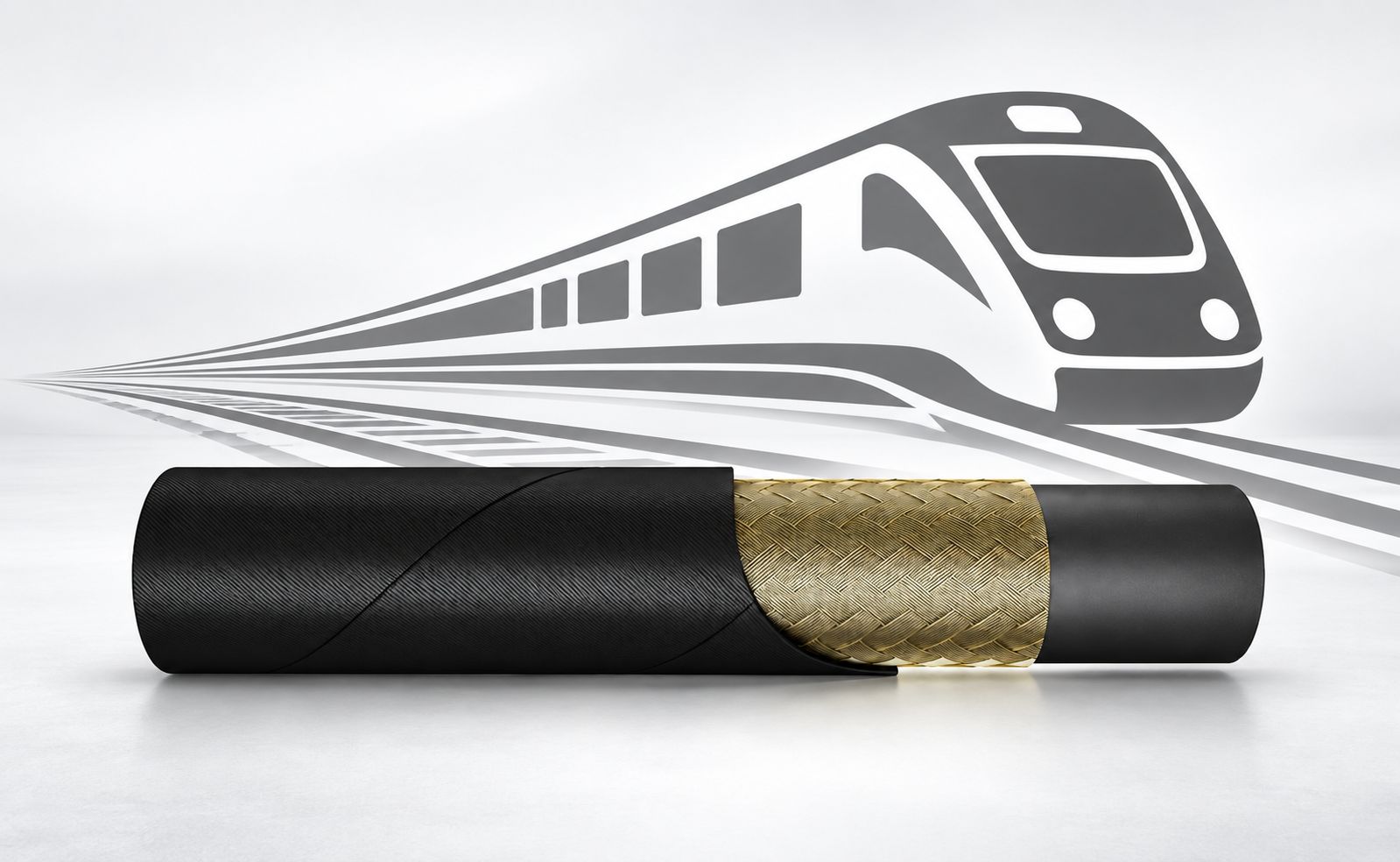
Railway hoses are specialized lines designed for hydraulic, auxiliary, and other systems used in rail vehicles. In locomotives, passenger cars, multiple units, and track machines, the hose must be selected not only in terms of diameter and working pressure but also requirements regarding material behavior in fire conditions. Therefore, hoses meeting the requirements of EN 45545-2 are used in railway applications.
Depending on the series, the offer includes low-pressure, suction, single-braid, double-braid, and compact hoses. This allows for selecting a solution for a specific installation site, required flexibility, medium flow, and working pressure.
Key features of railway hoses
- intended for rail vehicles and railway infrastructure,
- variants compliant with EN 45545-2 requirements,
- constructions compliant with, among others, EN 853, EN 857, EN 854, SAE, and ISO, depending on the hose type,
- versions with one or two steel braids,
- variants with synthetic braid for low-pressure installations,
- compact hoses with reduced bending radius,
- range of applications including pressure, return, and suction lines,
- resistance of the outer layer to ozone, abrasion, and operating conditions specific to the given series.
Application: suction hose for railway installations
What does EN 45545-2 mean for railway hoses?
EN 45545-2 specifies requirements for the behavior of materials and components used in rail vehicles under fire conditions. When choosing a hose, check the required hazard level HL and the classification of the specific hose series resulting from its technical documentation.
It should not be assumed that any hydraulic hose with the appropriate pressure can be used in a railway vehicle. A standard 1SN or 2SN hose may have a similar hydraulic construction but may not have the required classification for behavior under fire conditions.
How to choose a hose for a railway installation?
Correct selection starts with determining the function of the hose. A supply line operating under high pressure will have different requirements than a return hose, and yet another for a suction hose working with a tank and pump.
- specify the internal diameter DN,
- check the system's maximum working pressure,
- establish EN 45545-2 standard requirements for the given application,
- check the type of medium transported,
- verify the operating temperature,
- take the minimum bending radius into account,
- select fittings and ferrules compatible with the construction of the specific hose.
1SN, 2SN or compact hose 1SC or 2SC?
The 1SN hose has one steel braid and works where the required pressure does not necessitate a double-braid construction. The 2SN hose uses two steel braids and is designed for higher working pressures.
1SC and 2SC variants have a more compact design. Their advantage is the ability to route the hose in installations where mounting space is limited. This is important, among other things, in chassis, technical enclosures, and service areas of rail vehicles.
For return or low-pressure installations, constructions such as 2TE can be used, while on the suction side, a hose designed for vacuum operation is needed, e.g., a construction corresponding to SAE 100 R4.
Most common mistake in selecting a railway hose
One of the most common mistakes is selecting a hose solely based on diameter and pressure. Two hoses can have the same DN and similar working pressure but differ in bending radius, braid construction, allowable medium, and classification required for railway applications.
Incorrect selection can lead to excessive hose stress, accelerated cover wear, damage at the crimping point, or the need to replace the component again after verifying the vehicle's technical documentation.
Crimping railway hoses
A complete hose assembly must form a correctly selected system including the hose, fitting, ferrule, and the appropriate crimping technology. Crimping parameters should derive from the hose system documentation and the fittings used.
To manufacture hoses, appropriate hose crimping machinesare used. HYDRON also offers hose fittings in various connection standards.
When making a complete hose assembly, the fitting must be selected for the required installation, e.g., metric, BSP, JIC, or ORFS connection, while simultaneously checking the compatibility of the fitting itself with the specific hose construction.
Protection of hoses in difficult installation locations
In rail vehicles, hoses can operate near structural elements and in locations exposed to movement, vibrations, and contact with other system parts. If there is a risk of the hose surface abrading, it is worth using additional mechanical protection.
In such places, appropriately selected spiral hose guardscan be used. However, the guard does not replace proper hose routing and maintaining the minimum bending radius.
Custom-made hydraulic hose assemblies
If the installation requires a ready-made hose with fittings, you must specify the hose type, DN, total length, type of both ends, and their mutual orientation. Especially in railway installations, it is also essential to maintain compliance of the components used with the vehicle's technical documentation.
Check also custom hydraulic hoses available at HYDRON.
Railway hoses for service and rolling stock production
Hoses compliant with railway requirements can be used both during the production of new vehicles and for service work and operational replacements. The key is to replicate the hose parameters resulting from the technical documentation or to correctly design a new section of the installation.
In practice, this means checking not only the diameter and length but also the hose construction, pressure, temperature, bending radius, fitting type, and requirements resulting from the application in a rail vehicle. This approach reduces the risk of incorrect selection and increases the durability of the entire system.
FAQ - railway hoses
How does a railway hose differ from a standard hydraulic hose?
A hose designed for railway applications may have an additional classification regarding material behavior under fire conditions, e.g., compliance with EN 45545-2. A standard hydraulic hose with similar DN and pressure does not necessarily meet such requirements.
Can standard hydraulic fittings be used for railway hoses?
It depends on the specific hose series and the fitting system. Constructions corresponding to 1SN, 2SN, 1SC, or 2SC standards can work with appropriate hydraulic fittings, but compatibility of the hose, ferrule, and fitting must always be confirmed according to technical documentation.
Which hose to choose for high pressure?
Double-braid constructions, e.g., 2SN or compact 2SC, are primarily intended for higher pressures. The final selection depends on the required diameter, working pressure, temperature, and other installation conditions.
Does every EN 45545-2 hose have the same classification level?
No. The required level and classification should be checked for the specific hose type and vehicle application. Information about EN 45545-2 alone should not replace the verification of the technical documentation for a specific series.
How to select a suction hose for a railway application?
A suction hose must be resistant to vacuum and have a construction that prevents wall collapse. An example is a hose with a construction corresponding to SAE 100 R4, such as the Danfoss Railway EC190 variant described for railway applications.