










Thermoplastic hoses

Produkty z kategorii
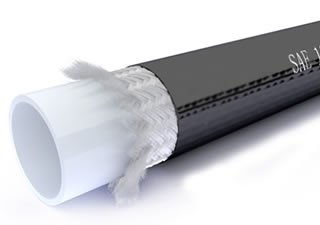

Thermoplastic hoses
Thermoplastic hoses are modern solutions used in power hydraulics, distinguished by their lightness, flexibility, and high resistance to abrasion and chemicals. Their inner and outer layers are made of thermoplastic materials, ensuring excellent strength in difficult working conditions. Thermoplastic hoses are designed for medium and high pressures. The base material is thermoplastic polymers (most often polyester, polyamide, polyurethane), and the reinforcement consists of one or two textile or steel braids. Production standards for thermoplastic hoses: Thermoplastic hoses offered in our store are produced according to international standards such as SAE 100R7 and SAE 100R8. These standards guarantee their reliability, precision of manufacture, and compliance with technical requirements for applications in high-pressure systems. The most important features of thermoplastic hoses are their compact design, which facilitates hose routing, and resistance to high pressures. Thermoplastic hoses can be replaced by standard 1SN hydraulic hoses, 2SN or smooth hydraulic hoses
Application of thermoplastic hoses
Thermoplastic hoses find wide application in machines and equipment such as: hydraulic lifts, agricultural machinery, injection molding machines, high-pressure washing equipment, industrial machinery, and other hydraulic systems requiring resistance to high pressures and variable environmental conditions. Thermoplastic hoses are most commonly used in forklifts, bucket lifts, cranes, hydraulic wrenches, rescue equipment, and other devices. Thermoplastic hoses are used not only for power hydraulics but also for painting (airless paintspray), compressed air and gases, chemicals, and water cleaning.
Hoses for medium and high pressures
Thermoplastic hoses are used in systems requiring medium, high, or very high pressure. Due to their ability to carry very high pressure, thermoplastic hoses are used, among others, in equipment / machinery powered by high-pressure hydraulic pumps ( ENERPAC etc. )
Silicone-free hydraulic hoses (LABS-free / PWIS-free)
At HYDRON, we also offer hydraulic hoses and industrial hoses available with a LABS-free / PWIS-free (Silicone-Free) statement. This solution is intended for industries where even trace amounts of silicone can negatively affect painting processes and coating quality. If you want to learn what the LABS-free standard is, when it is required, and how to order hoses with the appropriate documentation.
Types of thermoplastic hoses:
Types of thermoplastic hoses in the Hydron offer
- SAE 100R7 hoses – lightweight, durable hoses for medium-pressure hydraulic systems, ideal for general applications.
- SAE 100R7 twin hoses – double version for systems requiring double fluid conduction in a compact form.
- 1SN hoses – flexible hoses with steel braid that combine lightness and resistance to high pressures.
- SAE 100R8 hoses – hoses for high-pressure applications, characterized by increased resistance to abrasion and high temperatures.
How to choose the right hose for the application?
When choosing the right hose for a hydraulic application, it is crucial to consider factors such as working pressure, operating temperature, and the type of medium transported. Attention should also be paid to the material compatibility of the hose with the chemicals it will come into contact with. Additionally, it is important to determine requirements for flexibility and abrasion resistance to ensure long-term and trouble-free operation.
Advantages of thermoplastic materials
Thermoplastic materials in the production of hydraulic hoses offer exceptional lightness and flexibility, making them easy to install and use. They are also characterized by high resistance to abrasion and chemicals, which increases their durability in difficult working conditions. Additionally, thermoplastics are resistant to variable weather conditions, making them an ideal choice for outdoor applications.
Thermoplastic hoses – lightweight and durable solutions for power hydraulics
Thermoplastic hoses, commonly called “thermoplastics”, are a modern alternative to traditional rubber hoses used in power hydraulics. They are made of high-resistance plastics that become plastic under the influence of temperature and retain their shape and properties after cooling. Thanks to this, they are characterized by exceptional lightness, flexibility, and durability, which makes them superior to classic rubber solutions in many applications.
Advantages of thermoplastic hoses - lightness and compact design
The greatest advantage of thermoplastic hoses is their low weight – in comparison with standard hydraulic hoses ( 1SN, 2SN ) they can be up to half as light. This is of great importance in mobile machines such as excavators, lifts, forklifts, or agricultural machinery, where the reduction of the hose weight directly affects lower system load and energy savings. Thinner walls and smaller outer diameter while maintaining the required operating parameters make thermoplastics take up less space and easier to route in tight installation spaces.
Properties of thermoplastics - Resistance and flexibility in demanding conditions
Thermoplastic hoses perform excellently under high pressure, and their special construction with textile, aramid, or steel braid ensures safety and resistance to mechanical damage. They also stand out for their very good flexibility – they maintain their properties even with frequent bending, which makes them an ideal choice for devices requiring movable, dynamic connections. Thanks to their resistance to abrasion, UV radiation, ozone, and many chemicals, they can also be used in difficult outdoor conditions and in industrial branches where resistance to chemical media or paints is necessary.
Differences between thermoplastic and rubber hoses
In comparison with regular rubber hoses, thermoplastics age more slowly and retain their functional properties longer. They are irreplaceable where low weight, durability, and resistance to environmental conditions matter. In some cases – for example, at extreme temperatures or very high pulsating pressure – traditional rubber hoses with multi-layer steel braids may be a better choice. However, in the vast majority of applications, it is thermoplastics that are becoming the first-choice solution.
Thermoplastic hoses in the Hydron offer
At Hydron, we offer a wide selection of thermoplastic hoses meeting SAE, ISO, and DIN standards. All available products have appropriate certificates and approvals, and our team of experts advises on choosing the right type of hose for the requirements of a specific application. Thanks to this, our customers gain certainty that the selected hoses will work reliably for a long time, ensuring the safety and efficiency of the entire hydraulic system.
expand text Thin hydraulic hose – what makes it stand out?
Thin hydraulic hose – what makes it stand out ?
Thin hydraulic hose is a term used, among others, for thermoplastic hoses compliant with the SAE 100R8 standard. Unlike classic rubber hoses, they are characterized by smaller dimensions, a slim design, and greater flexibility, making them perfect for places with limited assembly space. The construction of these hoses is multi-layered, but at the same time compact. The core is made of durable thermoplastic material resistant to oils and hydraulic fluids. The reinforcement is a braid of synthetic or aramid fibers, which ensures high pressure strength. The outer cover made of polyurethane guarantees resistance to abrasion, UV radiation, and difficult weather conditions. Despite the slim construction, thin SAE 100R8 hydraulic hoses maintain full pressure resistance and meet safety requirements. As a result, they find application in systems requiring reliability and compact solutions.
Application of thin hydraulic hoses
Thin hydraulic hoses are ideal for mobile hydraulic systems where low weight and small bending radius are important. They are used, among others, in:
- forklifts,
- bucket lifts,
- construction machinery,
- agricultural equipment,
- cooling and painting systems.
They are also chosen for installations where chemical resistance and operation in a wide temperature range – from -40 °C to +100 °C – are important.