





Fluid power hydraulics - parts, accesories

Experienced Polish manufacturer & direct distributor of hydraulic components   
Retail & Wholesale – One-Stop Industrial Supplier | 100% European-owned    
   

six-time winner
Gazele Biznesu 2024

NATO supplier
Kod 99Q4H
Kod NCAGE Hydron

proven reliability
DUNS Numer Hydron

authorized
service
Autoryzowane centrum serwisowe ENERPAC w Polsce

official
distributorUSA
Autoryzowany dystrybutor ENERPAC w Polsce

official distributorUE SEMPERIT dystrybutor

quality assurance
ISO 9001, TUV
Certyfikaty Hydron ISO

📦 15,000+ items in our stock & ready to ship
⚡ Fast shipping 🛡️ Quality guarantee 🛠️ Technical support
Products in the cart: 0. See details
Your cart is empty
Open search engine
Search
Close search engine Clear Search

Sandblasting hoses

Products: None
Skip filters
Filters
End of filters

Produkty z kategorii

Products: None
List of products
There are currently no products in this category

Sandblasting, shot blasting hoses

Sandblaster hose 

Abrasive resistant hoses for sandblasting. Hoses used for, among others, plastering, shot blasting, and sandblasting with exceptional resistance to abrasion and atmospheric conditions. Special construction adapted for conveying glass, sand, shot, concrete, and other media, made from the highest quality materials including SBR rubber – fully protects hoses against internal abrasion and external deformation during operation in harsh conditions. Hoses can also be used for filling and emptying silos and tankers. Application of sandblaster hoses: sandblasting, shot blasting, transport of corundum, glass, sand, shot, etc. Types of sandblasting hoses: Sandblasting hoses on offer: FAGUMIT, SEMPERIT, STOMIL. 

Dimensions of sandblasting hoses 

We have hoses with different inner diameters and wall thicknesses 

  • 13mm (1/2") 
  • 19mm (3/4") 
  • 25mm (25x7),
  • 32mm (32x8),
  • 38mm (38x9)

Sandblasting and shot blasting hoses – different degrees of abrasion

Choosing the right hoses for sandblasting and shot blasting is very important. Sandblaster hoses are available in various variants that differ in the degree of abrasion. Thanks to the diverse range of hoses, every user will find a solution tailored to their needs - for light or intensive sandblasting work.  

Shot blasting hose - SM1 Semperit

The SM1 Semperit hose is an excellent choice for heavily used applications. It is characterized by high resistance to abrasion, which makes it ideal for transporting abrasive materials such as sand or shot. Its solid construction guarantees long-term use, even in difficult industrial conditions. Thanks to the flexibility of the hose, it is easy to adapt it to various sandblasting systems.

Sandblasting hose - SM2 Semperit

In turn, the SM2 Semperit hose is an option for more demanding applications. It offers an even higher degree of abrasion resistance, which makes it ideal for working with aggressive materials. Narrower diameters and increased flexibility make it great for narrow spaces, while providing high efficiency in transporting abrasive materials. 

What is sandblasting? 

Sandblasting is a processing process consisting in removing impurities, rust, paint or other materials from the surface of various materials, such as metal, wood or concrete. During sandblasting, a stream of fine-grained abrasive material is used, most often sand, which is ejected under high pressure using air or water. Types of materials used in sandblasting: sand -Most commonly used abrasive, shot - used in more demanding applications, especially in metal processing. granules - used for more delicate surfaces.

What are sandblasting hoses?
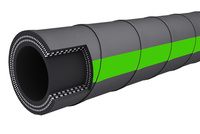
Sandblasting hoses are specialized conduits designed for operation in systems using an abrasive stream, such as sandblasters and blasting equipment. They are made of exceptionally durable materials that provide resistance to abrasion, high pressures, and difficult working conditions.

Which sandblasting hose to choose ?

The choice of the appropriate sandblasting hose depends on the type of device, type of abrasive, and specifics of the application. Sandblasting hoses offered by Hydron are characterized by: Abrasion resistance: The outer and inner layers of the hose are made of materials that minimize wear during operation with abrasive. Flexibility and durability: They facilitate installation and guarantee a long service life even in demanding conditions. Variety of sizes: Available in a wide range of diameters, which allows for matching to various sandblasters.

What pressure is needed for sandblasting ?

The operating pressure in sandblasters is usually from 4 to 8 bar, however, for more demanding tasks, a pressure of up to 10 bar is recommended. The sandblasting hoses available in our offer are adapted to work in such conditions, guaranteeing safety and reliability.

What is best for sandblasting ?

Hoses with an appropriate internal diameter work best for effective sandblasting, allowing for the free flow of abrasive without the risk of clogging. The choice of abrasive depends on the type of material being processed – hoses in our offer are compatible with various types of abrasives, such as: Quartz sand, Glass granules, Steel shot. Additionally, it is crucial to use hoses with high resistance to pressure and abrasion, which minimizes the risk of damage during work.

What length of sandblaster hose is best ?

The length of the hose depends on the specifics of the work and the requirements of the place where the sandblasting is performed. Standard hose lengths range from 10 to 20 meters, however, in some cases, such as work on large surfaces, longer conduits are necessary. At Hydron, we offer the possibility of adjusting the length of the hose to the individual needs of the customer.

Which sandblaster hose to choose

The selection of the appropriate conduit for sandblasting is crucial for work safety and the durability of the entire system. Answering the question of which sandblaster hose will be correct, one should primarily pay attention to abrasion resistance, internal diameter, and permissible operating pressure. The sandblasting process consists in transporting a mixture of air and abrasive under high pressure, which is why standard hydraulic or pneumatic hoses are not suitable for this application. A professional sandblaster hose should be made of rubber with very high abrasive resistance, often with an internal layer made of natural rubber or special wear-resistant mixtures. The wall thickness and reinforcement textile or steel, which ensures the stability of the structure during pulse operation, are also important. The diameter of the hose is selected depending on the compressor efficiency and the nozzle type. Too small a diameter causes pressure drops and limits cleaning efficiency, while oversizing can hinder the operator's work.

Which hose for a siphon sandblaster will be suitable?

In the case of siphon sandblasters, the requirements are slightly different than with pressure systems. Answering the question of which sandblaster hose to choose for a siphon one, one must take into account that the abrasive is sucked from the bottom tank using the vacuum effect generated by the air stream. A siphon sandblaster hose should: have high internal abrasion resistance, maintain flexibility with frequent movement, have an appropriate diameter ensuring stable transport of the abrasive, be resistant to bending and kinking. In practice, conduits with a smaller diameter than in pressure systems are used for siphon sandblasters, however, these must still be specialized sandblasting hoses, not standard air hoses.

Why isn't every hose suitable for sandblasting?

Transporting abrasive causes very intensive wear of the internal layer of the conduit. Using the wrong hose leads to: rapid wear of the wall, pressure loss, risk of the conduit bursting, danger to the operator. Therefore, when choosing a sandblaster hose, one should be guided not only by the diameter, but primarily by the material resistance and the manufacturer's intended use.

How to choose the sandblaster hose diameter for compressor capacity?

The choice of the sandblasting hose diameter should be strictly related to the compressor capacity expressed in m³/min and the diameter of the working nozzle. Too small a conduit diameter causes pressure drops, disturbances in the flow of the air-abrasive mixture, and a real drop in cleaning efficiency. In turn, an oversized hose with a small compressor will not bring flow benefits, but will only increase the weight and cost of the installation. In industrial practice, three parameters are key: compressor capacity (m³/min), sandblasting nozzle diameter, hose length. The larger the nozzle and the greater the air flow, the larger the sandblaster hose diameter should be.

Sandblasting hose table

The table below shows practical dependencies used in workshops and industrial installations:

Compressor capacity recommended hose dia. Typical application
2.5 m³/min
19mm (3/4") small sandblasters, workshop work
2.5-5 m³/min 19-25 mm mobile systems, medium nozzles
5-8 m³/min 25 mm (1") industrial sandblasting
above 8 m³/min 25 mm and more  high-performance installations

It is worth emphasizing that for hose lengths above 20–30 meters, it is recommended to increase the diameter to limit pressure losses.

Why is it worth choosing sandblasting hoses at Hydron ?

Highest quality materials ensure durability and work safety. Hoses compatible with various devices and types of abrasives. Wide choice of diameters and lengths. We help choose hoses optimal for your applications. The sandblasting hoses offered at Hydron are a reliable solution for professionals and amateurs who value efficiency and durability. Check our offer and choose the perfect hose for your sandblaster!

Sandblasting - shot blasting hoses


expand text What are abrasive resistant hoses?

What are abrasive resistant hoses ?

Abrasive resistant hoses are a specialized type of technical hoses that have been designed for operation in extremely demanding conditions where the conveyed medium (e.g., sand, gravel, granules, concrete, sludge, sawdust, dusts) causes intensive abrasion of the internal surfaces of the conduit. Thanks to their structure, they are significantly more resistant to mechanical damage than standard industrial or hydraulic hoses. These are flexible conduits made of materials with increased resistance to abrasion, such as special mixtures of natural rubber (NR), polyurethane (PU) or synthetic rubber (SBR, NBR). Their main task is to transport solid materials in loose form or liquid-solid mixtures in a safe and durable manner.

Characteristic features of abrasive resistant hoses

Increased resistance to abrasion – thick, specially reinforced internal walls significantly extend the life of the conduit. Resistance to bending and vacuum – many models have a construction that also enables operation in suction conditions. Flexibility – despite their strength, the hoses remain flexible, which facilitates installation and operation. Textile or steel reinforcements – allow them to withstand high working pressures and mechanical loads. Resistance to weather conditions and ozone – which allows them to be used both inside halls and outdoors.

Application of abrasive resistant hoses

Hoses of this type are used wherever there is transport of materials with strong abrasive properties:

• mining industry – transport of aggregates, sand, gravel, ores,

• construction industry – pumping concrete, mortar, sludge,

• wood industry – extraction of sawdust and chips,

• food and agricultural industry – transport of granulated feed, grain,

• chemical industry – conducting granules and chemical powders,

• dust extraction installations and pneumatic material transport systems.